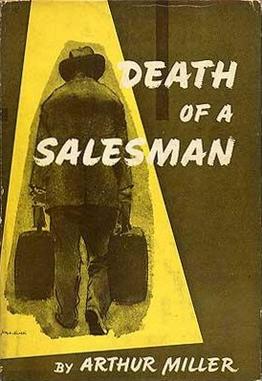
Synopsis of ‘Death of a Salesman’ by Arthur Miller

This Resource is for students studying the play ‘Death of a Salesman’ by Arthur Miller in the Victorian Curriculum.

See the source image

Analysing Issues = Using MAPS

Ask yourself these questions using the following 4 prompts to help you analyse the issues in Death of a Salesman:

  1. Message = What is the author’s message?
  2. Audience = Who is the audience?  How are they positioned?
  3. Purpose = What is the purpose and author’s point of view?
  4. Storytelling and Style Features = How are the characters portrayed?  How does the setting influence the story?  How does the plot shape characters?  What is the form and genre?  How does the form and genre influence point of view?  What language is used?

How does Death of a Salesman by Arthur Miller fit the theme of “Whose Reality?”

See the source image

Willy Loman, the protagonist of Death of a Salesman has been trading in deception all his adult life; in effect his livelihood has depended on it.  He is depicted by Miller as a flawed character.  Always a dreamer, Willy has swallowed the myth that material success represents the pinnacle of human achievement in the greatest country of the world, the USA, where anything is possible.  For a salesman, ‘reality’ is whatever sells.  Willy’s job has involved literally selling himself, inflating the truth, persuasion and making promises.  His world implodes when the reality of his personal and professional bankruptcy becomes impossible to hide.  Other members of the Loman family also thrive on self-deception and fantasy until their respective versions of reality bring them into conflict with each other and ultimately destroy the family unit.

The play’s atmospheric dimension is there to enhance the work’s narrative authority and appeal.  It is a compelling representation of the dark underside of the so-called American Dream.  Miller cleverly sets the scene for this stage play with his description of the Salesman’s house at the beginning of Act One as the curtain rises.  The stage directions emphasise the Loman family’s vulnerability with their home small and fragile compared to the advancing urban expansion.  The air of the dream, Miller says, “… clings to the place, a dream rising out of reality” (p.3 Act One).

In terms of “Whose Reality?” ultimately all the Lomans are trapped in the prison of their own subjectivity.  Willy confuses the past and present, truth and lies, fiction and fact.  He becomes increasingly alienated and disempowered.  By the end of the play he is lost in his delusions choosing dreams over reality which descend into a nightmare.

It is worth investigating the fact that self-knowledge is a threat to the protective veneer the Lomans have constructed for themselves.

The Question of Willy’s Death in the Play

See the source image

One huge issue raised by the play is the question of Willy’s death.  Is Willy a tragic hero or a delusional coward?  His death makes the reader question if Willy is wholly responsible for his reversal of fortune or if the world and post-war American society has failed a decent, hardworking man.  The two positions are not mutually exclusive and Miller’s text supports arguments for each.  It is your job to unpack these arguments in the text and decide for yourself what Willy’s downfall is due to.

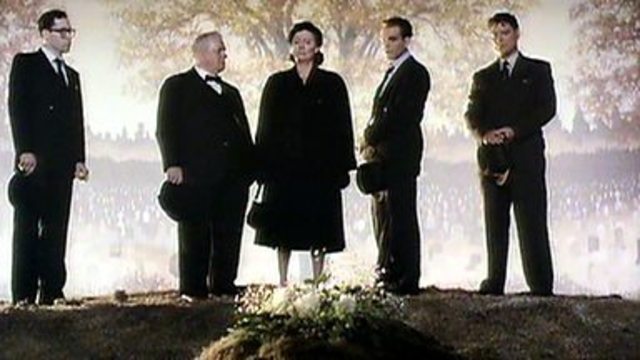
Even Willy’s family have contradictory perceptions on his suicide.  In Willy’s mind the decision to take his own life is a deliberate sacrifice, an attempt to salvage something from his unsatisfactory existence and put his family ahead of the game.  Willy’s bleak funeral is a far cry from the grand affair he has envisaged and a telling contrast to that of his icon Dave Singleman.  However, when Linda asks “Why didn’t anybody come?” to Willy’s funeral (p.119 The Requiem), Miller clearly underscores the divide between Willy’s illusions and the brutal reality of his professional world.  In the final analysis ‘attention’ (p.45 Act One) is not paid to such a small man, nobody cares except his family and one old friend.

Biff intones at his father’s graveside that “He had all the wrong dreams”…. “Charley, the man didn’t know who he was” (p.120 The Requiem).  While Biff is talking about Willy in this instance, all the members of the Loman family fabricate their own romanticised versions of reality that enable them to live with their failures.  However, it is Happy who uncritically articulates the creed that underpinned his father’s working life, to be ‘the number one man’ (p.120 The Requiem).  Happy is willing to absorb his father’s message without questioning its integrity.  It is left to his faithful friend Charley to speak in his friend’s defence to Biff when he says “Nobody dast blame this man.  A salesman is got to dream boy… It comes with the territory” (p.120 The Requiem).

Willy Loman is a Victim

One thing is certain; Willy in Death of a Salesman is a victim.  While Willy’s story is intensely personal, Miller has made him an archetypal character whose predicament exemplifies the fallout suffered by those who cannot meet the bottom line.  You have to ask yourself why Miller used the indefinite article “a” in the title of the play Death of a Salesman, suggesting that Willy is merely one of many such victims.


All Resources created by englishtutorlessons.com.au Online Tutoring using Zoom for Years 11 and 12 VCE Mainstream English Students in the Victorian Curriculum

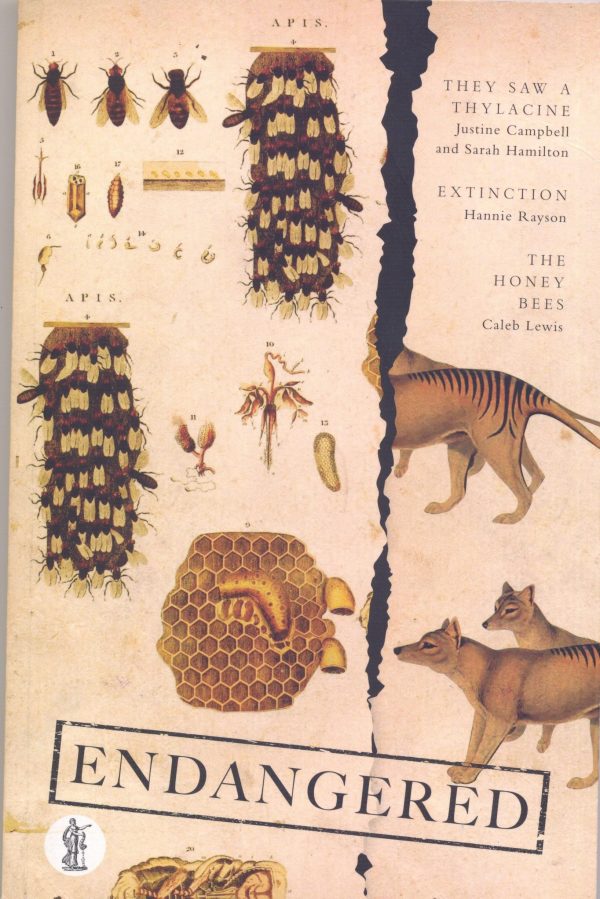
Characters in the play ‘Extinction’ by Hannie Rayson

This Resource is for Mainstream English Students studying the play ‘Extinction’ by Hannie Rayson in the Victorian Curriculum.

Analysing Characters in a Drama

When characters are portrayed by actors, characterisation depends on what is conveyed through visuals and sound as much as on the words in their dialogue. In this way playwrights can directly portray the many ways in which people communicate without using words. They can also use the aural qualities of speech to enhance and sometimes complicate the literal meaning of the character’s dialogue.

Characters and Stage Directions

When analysing a play script it is important to remember that the play is meant to be performed in front of an audience. While students are reading the play, take particular notice of the stage directions that can indicate essential visual elements of character, such as costumes, facial expressions and body movements. Pay attention to how the Director Hannie Rayson wants a word or line to be delivered by the actor, perhaps indicating an emotion such as anger or empathy and the vocal tone. The tone in the character’s language can link with the way the Director wants to convey information about the characters and how these words convey ideas and values to the audience.

See the source image

Characters and Relationships

In the play ‘Extinction’ the physical interactions with other characters is relevant to the themes and values Hannie Rayson wants the audience to connect with and reflect on their own values. Within the structure of the play all characters have equally important parts. Note how the Director wants to reinforce relatonships through thoughts and feelings and differences of opinions. The play presents the values of characters through their intense relationships with each other and the conflicts that arise between them. In ‘Extinction’ several characters compromise their core values in order to achieve their goals and the play highlights their difficult choices linking the tension between economic and environmental values that Hannie Rayson wants to endorse. It is Piper who says “We all exist in relationship with one another” and the concept of how vulnerable all life on earth is conveyed through the relationships of the characters in the play. Hannie Rayson wants to draw attention to how we all exist in relationship with other living creatures. She also wants the audience to recognise that human beings can be vulnerable and at times influenced by others in negative ways.

A Brief Synopsis of the Characters from the play ‘Extinction’:

  • Piper Ross

Dr Piper Ross is a 30-year-old American zoologist on secondment from the San Diego Zoo.  Piper works at CAPE and volunteers at a wildlife rescue centre in the Cape Otway rainforest run by veterinarian and boyfriend Andy Dixon.  Piper views the Otways as “paradise” (p.103) and values the restorative qualities of the Australian bush where her time in the wilderness allows her the chance to “renew” (p.78) herself to experience “awe” and “to feel reverence” (p.78).

An idealist who believes that all species are “worth saving” (p.83).  Piper is optimistic that “everyone transforming the way they live” (p.113) will be what saves the planet from destructive forces.  As a woman who values all life and considers it the role of every member of the human species to safeguard the lives of all animals, her anger at Andy when he euthanises the wounded tiger quoll is palpable. 

She is emotional and at times her judgement can be clouded.  While she is in love with Andy, she is unsure about his commitment to her which leads to her compromising her beliefs and values by having a sexual relationship with Harry Jewell and accepting a job from him.  She tells Harry that she wants to be a person who “faces up to things” (p.116) and ultimately, she is able to make a strong commitment to stand by her own words “if you loved someone and they were dying, you would do everything you could to help them (p.90).  This shows her courage and compassion.  It also enables her to redeem herself for the abandonment of her principles and her earlier betrayal of Andy.

  • Andy Dixon

Andy Dixon is the 35-year-old brother of Heather Dixon-Brown, in a relationship with Piper Ross, a vet and a committed conservationist, who is suffering from GSS a rare, hereditary, fatal neurodegenerative disease.  Andy, like the quoll, is a symbol of imminent extinction.  Rayson’s portrayal of Andy as the innocent victim of circumstances beyond his control reinforces a thematic link between him and the quoll.

Until the end of the play, only he and Heather know about his illness.  His seemingly heartless euthanising of the dying quoll reflects his embittered attitude to his own inevitable death.  He is unwilling to reveal the truth about his condition to Piper knowing she is the sort of person to “stay up all night looking after a bloody possum” (p.86) and rejects her desire to “marry … have babies and live in a house together” (p.104) seems to be part of his desire to spare her the pain of watching him degenerate and die.

He is an idealist who is passionate about the natural world and shows a strong commitment to environment values by condemning mining and even disapproves of using computers to run a diary farm (p.82).  Yet he is also “stubborn” and “rude” (p.106) when he disagrees or dislikes people.  This is true about his views of Heather’s acceptance of funds from Harry Jewell as “environmental vandalism” (p.119). 

Ultimately, Andy’s cynical worldview is challenged by the appearance of a live tiger quoll at the play’s conclusion.  In highlighting the fragility of life, Rayson reminds audiences not to take our survival, either as individuals or as a species for granted.

  • Heather Dixon-Brown

The 50-year-old director of CAPE, Heather Dixon-Brown, is the sister of Andy, boss of Piper, an ecologist in the process of a divorce and is acutely aware of her responsibility to ensure funding for the institute and the 25 people on staff at the institute who “rely on [her] to come up with their salaries” (p.79).  At first, she is portrayed to be a morally upright character, pragmatic and intelligent, aware of the issues that conservation faces with limited funding available.

Heather’s desire to assist endangered species with her Dixon-Brown Index is moderated by a realistic understanding that “You should only invest in those that are going to give you a good return” (p.99).  When Harry Jewell arrives on the scene, she compromises her environmental principles and her professional ethics by accepting his “dirty money” (p.100) and by sleeping with him.  She also uses spite and jealousy to try and get rid of Piper as a rival for Harry’s affections.  Rayson shows a stereotypical representation of an older woman who regards her own old age a disadvantage against the younger, Piper that Harry finds attractive, simply because he “prefer[s] a younger woman” (p.129).

  • Harry Jewell

A 45-year-old MD of Powerhouse Mining, Harry Jewell is recently divorced and has returned to the Otways in search of comfort.  Introduced by Rayson at the start of the play as a sensitive, charming and responsible character who is trying to save a quoll he has accidently hit, as the play progresses the audience see there are hidden depths and complexities to his character.  Andy calls him “Mr Evil” (p.80) and as such Harry has little sympathy for the farmers whose land he will destroy in his search for coal.  As a ruthless and heartless businessman, he is unlike the tender-hearted quoll rescuer in the opening scene of the play.

The audience and Piper struggle to come to terms with a man whose money enables him to live “a big life” (p.113) but who also seeks to use his fortune to do what he can to save the tiger quoll from extinction.  He recognises the harm the coal industry has done to the environment but also contends that “if you want to make a difference to the environment you have to be rich” (p.113).

Harry is also a shrewd operator, convincing Heather to accept funding from a coalmining company and uses his sexual power to exploit both Heather and Piper for his own enjoyment.  While he complains about his wife’s infidelity, he seems untroubled by his own duplicity. 

Through the construction of Harry’s character, Rayson makes a strong connection with the notion of extinction.  As a miner of coal, not only will Harry further erode the habitat of endangered species, but coal-fired energy will increase greenhouse gases, contributing to the unsustainability of life on earth (and hence extinction).

All Resources created by englishtutorlessons.com.au Online Tutoring using Zoom for Mainstream English Students in the Victorian Curriculum

Analysing and Presenting Argument

For Mainstream English Years 11 & 12 students studying Analysing Argument and Presenting Argument under the Victorian VCE Curriculum

Scope of the Task for Analysing Argument

Students analyse and compare the ways in which verbal and non-verbal (including visual) language of specified texts is used to persuade readers and viewers to share the point/s of view being presented. 40 marks are allocated to this task with a suggested 800-1000 word count.

Analysing Argument Basics

What are you trying to Analyse with the articles and visuals?

3 Basic Elements

  1. WHAT = What is the argument the author/s are making?
  2. HOW = How are techniques used by the authors?
  3. WHY = Why do the techniques used by the authors affect the audience? What is the Intention of the author to make the audience:
    1. THINK SOMETHING = LOGOS = a logical response = the author uses techniques like appeals to logic / expert opinions / research / reputable sources / statistics / graphs (these are some logical techniques)
    2. FEEL SOMETHING = PATHOS = an emotional response = the author uses techniques like appeals to emotion / attacks or praises / emotive language / figurative language such as idioms, cliches, alliteration, hyperbole, connotations, loaded words / inclusive language / rhetorical questions / appeals to family values (these are some emotional techniques)
    3. DO SOMETHING = ETHOS = an ethical appeal to act responsibly = the author wants the readers to actively lobby governments to act / call to action

Analysing Argument What You Need to Identify in the Articles & Visuals

  1. Identify and Annotate the Main Contention & Arguments
  2. Identify the Language and Techniques used to Persuade
  3. Identify the Intention of what the author wants the audience to Think/Feel/Do Something
  4. Identify the Audience & Tone
  5. Identify the Link between the Visual and Written Piece

Analysing Argument How to Identify Tone in Articles & Visuals

Tone refers to the mood or feeling of the language used by the writer conveying their attitude towards an issue, argument, individual or group.  In an article tone is created by word choices which have 3 main tones:

  1. Positive = reactive / amazed / astonished / quiet / calm / composed / thoughtful / approving / hopeful / caring / compassionate / sympathetic / lively / cheerful / enthusiastic
  2. Neutral = formal / authoritative / balanced / blunt / factual / frank / honest / serious
  3. Negative = passive / apathetic / dejected / apologetic / judgmental / pessimistic / uncontrolled / agitated / alarmed / fearful / forceful / accusing / angry / condemnatory / sarcastic / hateful

Presenting Argument Scope of Task : Oral Presentation

Unit 4 Outcome #2 Presenting Argument students will deliver a 5 minute individual Oral Presentation conveying a sustained and logical line of argument in response to a topic from the media worth 30 marks. 

Students should also write a Statement of Intention to articulate the purpose and intention of decisions made in the planning of the Oral which is worth 10 marks.  The SOI format should follow F/L/A/P/C = Form/Language/Audience/Purpose/Context.  The word count is determined by each school but is normally between 300-500 words.  See my Post on SOI requirement for years 11 & 12 for the full details on the FLAPC format.

(TOTAL FOR THIS OUTCOME 40%)

Students must deliver a 5 minute Oral Presentation demonstrating:

  • An ability to present a sustained and logical argument supported by a range of evidence from a variety of sources
  • An understanding of the power of language to persuade
  • An ability to address and convey the complexity of your chosen issue
  • An awareness of and ability to engage an audience
  • Submit a transcript of your speech and complete a bibliography
  • Produce a Written Statement of Intention articulating the intention of decisions made in the planning process of the oral presentation and how these demonstrate understanding of argument and persuasive language
  • The SAC will be worth a total of 40 marks = 30 marks for the oral + 10 marks for the SOI

 A few tips on writing your speech:

  • Have a CAPTIVATING introduction sentence; use a short, clear and powerful sentence. You can even ask a rhetorical question of your audience to make them think right at the start.
  • Make sure your MAIN CONTENTION is clearly spelled out at the start.  If you are vague about what you are trying to argue then the listeners (the Teachers marking the Oral) will not know what your Oral is about and will mark you down.
  • RELATE to your audience so that it keeps them interested so they actually WANT to listen.
  • If you are taking on a persona, firstly study and UNDERSTAND your character. (A persona is how you present your speech, ie. in a friendly voice, a business type strictly formal speech or using lots of colloquial phrases).
  • Don’t forget your persuasive techniques. Use repetition and rhetorical questions, emotive language and inclusive language.
  • Remember that you are delivering a SPEECH, not an essay. Instill your oral with emotion, varied tone and sentence lengths.

A few tips on your performance:

Memorise your speech

Practice as much as possible; in front of anyone and everyone including yourself (use a mirror).  Keep practicing until you can recite it.  Use your timer on your mobile phone to make sure you keep within the 5 minutes. As for cue cards, use dot points.  Remember to number the cue cards for safety so if you get nervous during the Oral and unfortunately drop them, at least you can pick up the cards and put them back in the right order.

This Resource is created by englishtutorlessons with Online Tutoring of English Using Zoom

Ransom by David Malouf

Brief Synopsis of Ransom by David Malouf 

Ransom

This Resource is for students studying Mainstream English in the Victorian Curriculum using these notes as background information to understand the narrative written by David Malouf.

Ransom by David Malouf is derived from the final section of Homer’s The Iliad

Drawn from a section of the Ancient Greek poet Homer’s The Iliad, David Malouf’s poignant novel Ransom explores the themes of revenge, redemption and fate during the Trojan War.  The common theme of all Greek mythology concerns powerful gods, heroes, mythological creatures and humans. These myths have had major influences in art and culture, and even during modern society today with its teaching of our beginnings, history, morals and lessons for our daily lives.  While The Iliad is heavily focused on the gods and the battles fought amongst the people, Ransom explores a new avenue of human relationships through two main characters: Achilles, the greatest warrior and hero of the Trojan War and Priam, the elderly king of Troy who has lost his son in battle.

The Historical Action of Ransom

David Malouf structured the characters and events of Ransom during the 9th year of the legendary Trojan War in The Iliad (around 1100 BCE).  Where as-yet untold stories might emerge, Malouf created an inner life for his main characters Achilles and Priam that are not told in the Iliad.  The novel plays out over one full day and the following morning, although Malouf has allowed his characters flash-backs and flash-forwards that weave significant events into the narrative.  Ransom commences on the 12th day after the death of the Trojan hero Hector, son of Priam King of Troy who is slain by the famed Greek warrior Achilles in revenge for the death of his loved step-brother Patroclus.

The Human Action of Ransom

In Ransom both Priam and Achilles must face and overcome dilemmas.  Each questions the role he has been playing.  The narrative allows the characters to liberate themselves from a crisis of personal values and a loss of self-esteem, something quite different from the view of human action in The Iliad.   Malouf presents his main characters with moral and imaginative courage in choosing to act beyond the bounds of their normal roles.  Both Priam and Achilles come to a new understanding of what it means to be human.  Priam, dressed simply and with no weapons or crown, pleads with Achilles to release Hector’s body.  He appeals to his humanity and in doing so raises the question of what it means to be ‘human’.  Are the characters ruled by animal instincts, by the influence of the gods or by human reason and feeling?  A blend of all these facets suggests the permeable, open nature of human beings in the novel.

The Importance of Family Affection and Father-Son Relationships

Priam reminds Achilles of the importance of family affection and the closeness of father-son loyalty.  They are both fathers and sons before anything else.  They are also mortals where death is always present.  Priam begs Achilles “… as a father, and as one poor mortal to another – to accept the ransom I bring and give me back the body of my son” (p.182).  Priam wants Achilles to act as both their “… fathers and forefathers have done through all the ages” to show that they are in effect “men, children of the gods and not ravening beasts” (p.183).

Pity and Compassion

Even in the long, harsh war between the Trojans and Greeks, enduring human values emerge.  Malouf has allowed his main characters to express compassion and pity that we see goes beyond social class and political beliefs.  Priam pleads with Achilles as one human to another, since they all die in the end, he argues they should feel each other’s sorrows now and be compassionate.  He asks Achilles to think of his son Neoptolemus, and his father Peleus “Would you not do for him what I am doing here for Hector?  Would your father Peleus, not do the same for you?” (p.184).  Achilles’ personality is influenced by its origins.  We see this in flashbacks in the novel of Achilles expressing his love for his son and his father.  Priam has made Achilles contemplate Hector’s body and his own death with fresh respect.  In pitying Priam as a father, Achilles is reminded of his own son Neoptolemus and changes his view of Hector.  Achilles allows Priam to take the body of Hector in exchange for the ransom of gold in the wagon.  In a key moment between the warrior Achilles and the king Priam, their physical gesture of reconciliation is shown “Quietly, as they ate together, he and Achilles had discovered a kind of intimacy; wary at first, though also respectful” (p.198).

Taking a Chance – Choosing Action

The concept that humans have free will to act and should take opportunities as they come was foreign to the ancient Greeks, who believed that human life is governed by larger powers such as greater destiny or supernatural beings.  Malouf’s narrative allows each of these approaches to work in the story.  We see some of the characters decide to risk action and take a chance, yet they still accept the workings of fate and the interferences of the gods.  The novel invites the reader to ask questions about our own beliefs.  Should we believe in fate or chance?  How should a person decide?

Priam acts in an unexpected way to achieve a positive goal when he decides to follow chance rather than passive customs.  In doing so he must oppose those close to him who expect the king to always be predictable to “… follow convention, slip his arms into the sleeves of an empty garment and stand still”.  Instead Priam steps “… into a space that till now was uninhabited and found a way to fill it” (p.208-209).  He feels “bold” and “defiant” rather than passive and dismissive “sure of his decision” (p.49) to retrieve the body of his dead son Hector from the camp of his enemy Achilles.

Achilles’ reputation, well known throughout the territory, was capitalised by Patroclus to frighten the Trojans and inspire the Greeks to fight on.  Despite the years spent earning this reputation, this would not be what Achilles would be remembered for.  Malouf shows us the raw emotional side of Achilles with his grief for the death of Patroclus.  In fact by dragging the dead body of Hector each morning behind his chariot, Achilles “… breaks daily every rule [his men] … have been taught to live by.  Their only explanation is that he is mad” (p.29).  Achilles tells himself his “half-blind rage” is for Patroclus “But it is never enough.  That is what he feels.  That is what torments him” (p.33-34).  Releasing Hector’s body to Priam is his greatest challenge and act in the novel.  It is Achilles acceptance of his role as a hero-warrior that brings him peace in Part IV.

Private Online Tutoring of English using Zoom

Poetry Analysis Step by Step

Why Read Poems?

Some people say they don’t like poetry, it’s boring or they don’t understand it.  I think poetry is more like a song, the more you hear it the more you like it.  The words are very similar to poetry; in fact we can break down the verses of songs and see the meaning as poetry.

Poetry doesn’t have to be boring; it can also be funny like limericks.

Start with a Step by Step Analysis

Have a look at this Poetry Analysis Step by Step Flow Chart in PowerPoint to show you the way to read and understand a poem.  Follow it below as well with a full explanation of the Poetry Analysis Step by Step.

Poetry Analysis flow chart

1. Read a poem 2 or 3 times

Each time you read a poem you notice different things

When you read the poem a second time you pick up on ideas and themes that you may have missed the first time you read it.  Also the poet can have ideas hidden just below the surface of the words and as you read it again, the new ideas can jump out.

2. Paraphrase the poem by stanza next to the original text

Writing it in your own words is a good idea to make sense of the poem, so you know what it means in simple terms

Stanza means the verses of the poem just like a song

How the poet organises the stanzas in a poem is often an important aspect of the poem’s structure.  Nothing in a poem is by accident.  Poets choose their words carefully as well as giving careful thought to the form and layout of the poem.  You should ask yourself why the poet has done this or that because there will be a reason and there is an effect for everything in a poem.

3. Answer the 5 W’s

Who? Who is the poet referring to?

What? What is the poem about?

Why? Why is the poet writing about it?

When? When is the poem set, the time period?

Where? Where is the poem, the place the poet is taking about, the setting?

4. Identify the theme, message or topic

What is the poet trying to say? What is the poet’s message in the poem?

What is the point? Is the poet trying to make a specific point in the poem?

5. Identify and Highlight Examples of Literary Techniques

Simile

Definition: Simile is when you compare two nouns (persons, places or things) that are unlike, with “like” or “as.” “The water is like the sun.”  “The water is like the sun” is an example of simile because water and the sun have little in common, and yet they’re being compared to one another. The “is” is also part of what makes this stanza an example of simile. “The rain falls like the sun,rising upon the mountains.”

Metaphor

When something is described in terms of something else, ‘her eyes are the stars in the sky’ is a metaphor as one thing her eyes is being described in terms of another thing the stars. Metaphors are comparisons that show how two things that are not alike in most ways are similar in one important way. Metaphors are a way to describe something. Authors use them to make their writing more interesting or entertaining. Unlike similes that use the words “as” or “like” to make a comparison, metaphors state that something is something else.

Imagery

Poets use words to create images in your mind.

Alliteration

This is the repetition of a consonant sound in the words.  For example slippery slithering snake is alliteration.

Personification

This is where human qualities or emotions are given to non human things.  The wind howled in agony all day.  He gazed at the angry sea.

Tone

The overall mood of the poem, the emotions can be sad, optimistic, solemn.

Point of View

From what point of view is the poet writing.

Online Tutoring of English using Zoom

Poetry of Robert Frost

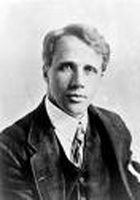
Robert Frost

Robert Frost

Frosts poetry is a Metaphor for the ways in which we make sense of our lives

The ways in which people develop their imaginative landscapes, their attitudes and values and how they respond to the world around them are influenced by their sense of place.  In analysing texts the landscape may be seen in literal or metaphorical terms.  Places where we have lived and people we have lived with contribute to our outlook on life and how we respond to particular situations.  For some people these memories stay with them throughout life.  The imaginative landscape derives from the diversity of these experiences over the years.  The physical landscape of a person’s life forms a literal and metaphorical yardstick with which to measure the passage of time and the acquisition of personal characteristics.  The physical becomes intertwined with their imaginative landscape.

Robert Frost’s Imaginative Landscape

Encompasses both the beauty and dark side of the land and of human nature.  While his love of the natural world is evident, inspiring him as a poet and a person, he does not romanticize it, rather he imbues it with strong moral tones, reflecting in his love of rural America.

As well as describing the physical world, Frost is also preoccupied with how the human figures are placed in the landscape and in time.  His characters are aware of where they have come from and their history.  They move in time from the past but also encompass the future.  Frost’s imaginative landscape helps us to construct versions of ourselves by exploring where and who we have come from and who we might become.

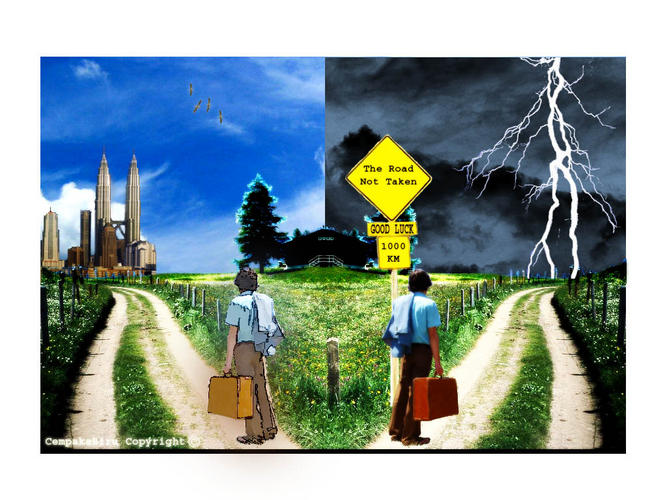
‘The Road Not Taken’ Poem by Robert Frost

See the source image

The speaker stands in the woods, considering a fork in the road.  Both ways are equally worn and equally overlaid with un-trodden leaves.  The speaker chooses one, telling himself that he will take the other another day.  Yet he knows it is unlikely that he will have the opportunity to do so.  He admits that someday in the future he will recreate the scene with a slight twist, he will claim that he took the less-travelled road.

One of the attractions of this poem is its archetypal dilemma, one that we instantly recognise because each of us encounters it numberable times, both literally and figuratively.  Paths in the woods and forks in the roads are ancient and deep-seated metaphors for life, its crises and decisions.  Identical forks, in particular, symbolise for us the nexus of free will and fate.  We are free to choose, but we do not really know beforehand what we are choosing between.  Our route is, thus, determined by an accretion of choice and chance, and it is impossible to separate the two.

The Fourth Stanza Holds the Key to the Poem with 2 Tricky Words

“I shall be telling this with a sigh

Somewhere ages and ages hence:

Two roads diverged in a wood, and I –

I took the one less traveled by,

And that has made all the difference”.

Those who interpret this poem as suggesting non-conformity take the word “difference” to be a positive difference.  There is nothing in the poem that suggests that this difference signals a positive outcome.  The speaker could not offer such information, because he has not lived the “difference” yet.

The other word that leads non-discerning readers astray is the word “sigh”.  By taking “difference” to mean a positive difference, they think that the sigh is one of nostalgic relief.  However, a sigh can also mean regret.  There is the “oh, dear” kind of sigh, but also the “what a relief” kind of sigh.  Which one is it?  We do not know.

See the source image

If the the sigh is one of relief, then the difference means the speaker is glad he took the road he did.  If the sigh is one of regret, then the difference would not be good, and the speaker would be sighing in regret.  The speaker of the poem does not even know the nature of that sigh because that sigh and his evaluation of the difference his choice will make are still in the future.  It is a truism that any choice we make is going to make “all the difference” in how our future turns out.

Private Online Tutoring of English using Zoom


Basic Debating Rules

This Resource is for students studying Mainstream English in the Victorian Curriculum.

See the source image

Basic Debating Rules: Starting with an Explanation of What is a Debate?

A debate is basically an argument with strict rules of conduct.  It is not a shouting match between two sides with different points of view.

Topic Sides

There are 2 sides in a debate:

  1. The Affirmative agrees with the topic
  2. The Negative disagrees with the topic

The Team Line

Three speakers work together as a team.  The Team Line is the basic statement of “why the topic is true” (for the affirmative team) and “why the topic is false” (for the negative team).  It should be a short sentence, presented by the first speaker of each team and used by the other two speakers to enforce the idea of teamwork.

The Debate Announcer and Time Keeper

  1. The Debate Announcer introduces the topic and the students on each team
  2. The Debate Announcer mentions that each speaker will be timed, the minimum speech is 3 minutes and the Time Keeper will tap on the desk when the 3 minutes has elapsed so the Speaker knows
  3. Each team will have the same allowance for time

Speakers

Each side has 3 speakers who speak in order:

First Speaker of the Affirmative Side Must

  • define the topic
  • present the Affirmative team’s line
  • outline briefly what each speaker in their team will talk about
  • present the first half of the Affirmative case

First Speaker of the Negative Side Must

  • accept or reject the definition.  If you don’t do this it is assumed that you accept the definition.
  • present the Negative team’s line
  • outline briefly what each of the Negative speakers will say
  • rebut a few of the main points of the First Affirmative Speaker
  • the First Negative Speaker should spend about one quarter of their time rebutting
  • Present the first half of the Negative team’s case

Second Affirmative Speaker Must

  • reaffirm the Affirmative team’s line
  • rebut the main points presented by the First Negative Speaker
  • the Second Affirmative Speaker should spend about one third of their time rebutting
  • present the second half of the Affirmative team’s case

Second Negative Speaker Must

  • reaffirm the Negative team’s line
  • rebut some of the main points of the Affirmative’s case
  • the Second Negative Speaker should spend about one third of their time rebutting
  • present the second half of the Negative team’s case

Third Affirmative Speaker Must

  • reaffirm the Affirmative team’s line
  • rebut all the remaining points of the Negative team’s case
  • the Third Affirmative Speaker should spend about two thirds to three quarters of their time rebutting
  • present a summary of the Affirmative team’s case
  • round off the debate for the Affirmative team

Third Negative Speaker Must

  • reaffirm the Negative team’s line
  • rebut all the remaining points of the Affirmative team’s case
  • the Third Negative Speaker should spend about two thirds to three quarters of their time rebutting
  • present a summary of the Negative team’s case
  • round off the debate for the Negative team
  • neither Third Speaker may introduce any new parts of their team’s cases

Importance of Rebuttal

In debating, each team will present points in favour of their case.  They will also spend some time criticising the arguments presented by the other teamThis is called Rebuttal.

There are a few things to remember about Rebuttal:

  1. Logic – to say that the other side is wrong is not enough.  You have to show why the other side is wrong.  This is best done by taking a main point of the other side’s argument and showing that is does not make sense.  A lof of the thinking for this needs to be done quickly and this is one of the most challenging aspects of debating.
  2. Pick the important points  – try to rebut the most important points of the other side’s case.  You will find that after a while these are easer to spot.  One obvious spot to find them is when the first speaker of the other team outlines briefly what the rest of the team will say.
  3. Play the ball – do not criticise the individual speakers, criticise what they say.

The Manner of how you present your debate is important

The manner is how you present what you say and the best manner style is definitely not to shout and thump the table but to keep calm and present your points with a clear speaking voice.  Here are a few tips that might come in handy with your debating style:

  1. Use Cue Cards – debating is a lively interaction between two teams not just reading a speech off notes.  Use cue cards like a prompt in a play as a reference if you lose your spot or train of thought.
  2. Use Eye Contact – if you look at the audience you will hold their attention.  If you spend the whole time reading from your cue cards or looking at a spot away from the audience, they will lose concentration very quickly.  Keep the audience in your sight and their minds will follow your logic.
  3. Your Voice – you must project your voice so that you can be heard but definitely do not shout.  Use the volume, pitch and speech of your voice to emphasise important points of your speech.  Sometimes a loud burst will grab the audience’s attention while a period of quiet speaking will draw the audience in and make them listen more carefully to what you are saying.
  4. Your Body – Make your body work for you by using hand gestures with confidence.  Move your head and upper body to maintain eye contact with all members of the audience.  Stand straight up, definitely do not slouch over the desk or let the audience know you might be nervous.
  5. Nervous Habits – avoid them like the plague.  Playing with the cue cards, pulling strands of your hair, fiddling with your watch or bouncing up and down on your feet will all distract from what you are saying.  Don’t let any one thing detract from your ability to persuade the audience.
  6. Using Big Words – try to avoid going overboard with big words and confusing people.  If you don’t understand the big words yourself then the chances no one else will understand what you are saying either.  It would be a huge mistake to debate and get stuck on a word that you are not sure what it means but also one that you can’t pronounce.

The Marking Scheme in a Debate

Every adjudicator marks to a standard.  You will get a mark out of 40 for matter, manner and method with a total mark out of a 100.

This Resource is created by englishtutorlessons with Online Tutoring Classes using Zoom


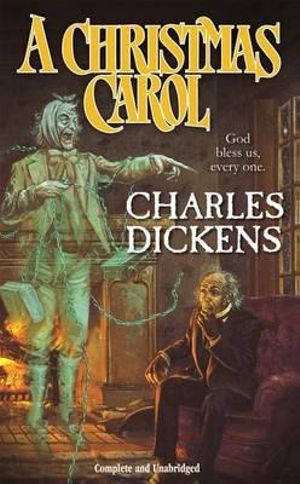
Brief Synopsis of ‘A Christmas Carol’ by Charles Dickens

What is A Christmas Carol by Charles Dickens about?

Set in the 1840s on Christmas Eve, A Christmas Carol by Charles Dickens chronicles the personal transformation of the protagonist, Ebenezer Scrooge, the proprietor of a London counting house.  A wealthy, elderly man, Scrooge is considered miserly and misanthropic: he has no wife or children; he throws out two men collecting for charity; he bullies and underpays his loyal clerk, Bob Cratchit; and he dismisses the Christmas dinner invitation of his kind nephew, Fred.  Moreover, Scrooge is a strong supporter of the Poor Law of 1834, which allowed the poor to be interned in workhouses.

As he prepares for bed on Christmas Eve in his solitary, dark chambers, Scrooge is visited by the ghost of his former partner, Jacob Marley.  In life Marley was very similar in attitude and temperament to Scrooge: remote, cruel, and parsimonious.  In death he has learned the value of compassion and warns Scrooge to reform his ways before it is too late.  Marley announces that Scrooge will be visited by three more specters: the Spirits of Christmas Past, Present, and Yet to Come.

The Ghost of Christmas Past takes Scrooge back to his unhappy childhood, revealing that the young boy’s experiences with poverty and abandonment inspired a desire to succeed and gain material advantage.  Unfortunately, Scrooge’s burgeoning ambition and greed destroyed his relationship with his fiancée and his friends.

The Ghost of Christmas Present is represented by a hearty, genial man who reminds Scrooge of the joy of human companionship, which he has rejected in favor of his misanthropic existence.

Finally, the Ghost of Christmas Yet to Come appears in a dark robe and shrouded in mystery.  Silently, the ghost reveals the ambivalent reaction to news of Scrooge’s own death. Scrooge realizes that he will die alone and without love, and that he has the power and money to help those around him – especially Bob Cratchit’s ailing son, Tiny Tim.  Scrooge begs the ghost for another chance and wakes in his bed on Christmas morning, resolved to changing his life by being generous and loving to his family, employees, and the poor.

Classifying A Christmas Carol

For some readers A Christmas Carol resonates as a gothic ghost story, at times chilling and terrifying and at other times, extremely funny.  Other readers see the story as a time travel narrative.  Dickens in effect blended realism and the supernatural to create a world in which the gothic and the mundane sit side by side.  Dickens himself said he was here taking old nursery tales and “giving them a higher form” (Stone, Harry 1999, ‘A Christmas Carol: Giving Nursery Tales a Higher Form’).  With its dark, chilly setting and its supernatural visitors, A Christmas Carol draws on elements of the gothic novel when Scrooge’s door-knocker turns into Jacob Marley’s face.  The narrator provides a number of descriptions in which gothic elements are interwoven with freezing, icy imagery to emphasise the atmosphere of mystery and to remind us of the protagonist’s icy heart.

A Christmas Carol as a Cultural Myth

According to Juliet John, A Christmas Carol has become a “cultural myth” providing “a parable for the modern, commercial age” (John, Juliet 2011, ‘Dickens and Mass Culture’).  As a morality tale, in which evil is exposed, virtuous characters like the Cratchits are rewarded, and everyone celebrates at the conclusion.  However, there are issues raised in A Christmas Carol that remain unresolved at the conclusion of the novel. The sinister children of Want and Ignorance, do not go away just because Scrooge has been reformed, but the narrator tells us nothing of their future.  Their role is more allegorical than that of other characters. Dickens uses them as an important warning to his readers and to Scrooge as the frighteningly ugly face of 19th century poverty.  Unless social reform takes place urgently, Want and Ignorance will grow into hungry, resentful predators.  The fact that Dickens even raised the issue of the miserable lives of street children at all marks an important attempt by him to make his readers ponder their own social responsibilities.

Historical Context of A Christmas Carol 

While A Christmas Carol is primarily received as a ghost story, it is also a damning expose of social inequality in 1840’s Britain.  Dickens was deeply agitated by what he perceived as the inertia of the British government and wealthy middle classes to help those less fortunate than themselves.  A Christmas Carol was written at the beginning of the ‘Hungry Forties’ a period that encompassed the catastrophic Irish potato famine, as well as intense suffering for the English working classes.  Dickens uses A Christmas Carol to not only attack the Utilitarian philosophy of Jeremy Bentham, who justified the centralisation of Poor Relief in workhouses, but also to lambast the work of Thomas Malthus in his Essay on the Principle of Population.  Whilst in abstract these principles might seem logical, when applied to suffering individuals, their underlying brutality becomes obvious.

Ebenezer Scrooge

For most readers Scrooge represents the worst charactertistics of his society.  Fixated with material goods at the expense of all human connection, particularly with his clerk Bob Cratchit, Scrooge is an allegorical embodiment of the forces of capitalism underpinning Britian’s economy in the 1840’s.  For Dickens, he represented everything that was wrong with society in an increasingly industrialised world where human relations took second place to profits.

Dualism in Dicken’s Writing

The world of the early Dickens is organized according to a dualism which is based in its artistic derivation on the values of melodrama: there are bad people and there are good people, there are comics and there are characters played straight. The only complexity of which Dickens is capable is to make one of his noxious characters become wholesome, one of his clowns turn out to be a serious person. The most conspicuous example of this process is the reform of Scrooge in A Christmas Carol shows the phenomenon in its purest form.

We have come to take Scrooge so much for granted that he seems practically a piece of Christmas folklore; we no more inquire seriously into the mechanics of his transformation than we do into the transformation of the Beast into the young prince that marries Beauty in the fairy tale. Yet Scrooge represents a principle fundamental to the dynamics of Dickens’ world and derived from his own emotional constitution – though the story, of course, owes its power to the fact that most of us feel ourselves capable of the extremes of both malignity and benevolence.

Redemption in A Christmas Carol 

Can A Christmas Carol be seen as a tale about redemption in a man who has ostracized himself from his society?  While the narrative is focused on Ebenezer Scrooge’s learning experiences and his reintegration into the community, his story also forms part of a broader allegory through which Dickens invites his readers to consider Christmas as a time of renewal and hope and to think about how they themselves might redeem and be redeemed.

The ‘Scrooge Problem’ – the Questioning of Scrooge’s Transformation

Elliot L. Gilbert’s essay: ‘The Ceremony of Innocence: Charles Dickens’ A Christmas Carol’ addresses ‘the Scrooge problem’, that is, the critical tradition of questioning the sincerity of Scrooge’s sudden transformation from being mean-spirited to kind-hearted.  Gilbert admits that his support for Scrooge’s change of heart is not free from doubt, as similarly to House and Johnston, he feels that the ease of Scrooge’s alteration is questionable. Furthermore, to accept the overnight metamorphosis of a man who has spent a lifetime bullying clerks, revelling in misanthropy and grinding the faces of the poor, is ‘to deny all that life teaches in favour of sentimental wishful thinking.’

Gilbert’s essay provides a new hypotheses to explain the reader’s misgivings regarding the plausibility of Scrooge’s radical conversion; he is merely returning to his childhood innocence. He explains why he views A Christmas Carol to be metaphysical; it is because it portrays the journey of a human being trying to rediscover his own childhood innocence. Such innocence Gilbert claims is evident in Scrooge’s encounter with the ghost of Christmas past, when Dickens has Scrooge’s fiancé break off their engagement, because the man she sees before her is not the man she first knew. Here, he reveals that Scrooge was not always bitter and mercenary, and therefore not so different from the man we are shown at the end of the novel. Thus, Scrooge’s new self is believable as it is in part his old self.

Private Online Tutoring of English using Zoom

Unit 3 Reading & Creating Texts Year 12 English Analytical Text Response

Image result for pictures of people reading books

This is an educational resource for Mainstream English Year 12 students who are studying Unit 3: Reading and Creating Texts: Analytical Text Response.

This resource material assumes year 12 students have read their Analytical Text or in some cases watched the movie related to this unit.

Most English classes discuss either the Creative Task or Analytical Task in their year 11 ‘Transition Classes’ to year 12 English (some schools call this ‘Head-start’) before the end of Term 4 in 2019.

If you have not read your texts for either the Creative or Analytical Tasks or watched the movie, then please do this over the school holidays so you are ready for Term 1 in January 2020.

What are the Task Requirements for Unit 3 Analytical Text Response?

  1. The Analytical Task is worth 30 marks for Unit 3.
  2. The analytical text response must be in written form (an essay that responds to a prompt).
  3. Approximately 800-1000 words in length, completed under SAC conditions, set by your respective school.
  4. In this area of study students identify, discuss and analyse how the features of selected texts create meaning using textual evidence to support their responses and how they influence interpretation.
  5. Students identify and analyse explicit and implied ideas and values in texts.

What does a High-level Analytical Response Include?

  1. Students must show a detailed knowledge and understanding of the world of the text.
  2. Look carefully at characters, events, settings, narrative, language and other textual features.
  3. Support their interpretation of arguments and statements about the texts with evidence, including quotations that are integrated into the discussion.
  4. Be able to discuss and analyse the values expressed by the text, especially the ‘Message of the Author’ in a text or the ‘Message of the Director’ in a film.
  5. Clearly show that your response links to the text and essay topic given.
  6. Structure the response logically using TEEL, with an Introduction / Body Paragraphs / Conclusion that develop your ideas and reasons why you support your interpretation of the essay prompt.
  7. Use high-level metalanguage appropriately to discuss textual features which should include narrative voice, imagery, stage directions (if text is a play), cinematography (if text is a film) and explain their significance.

See below an Example Introduction Analytical Text Response for a prompt on After Darkness by Christine Piper.  The Introduction has its Main Contention and Message of Author Colour Coded.

Prompt: “What else, through my misguided loyalty had I failed to see?”  After Darkness shows that loyalty is not always a virtue. Discuss.

Introduction / Main Contention / Message of Author

The historical novel After Darkness, by author Christine Piper, explores how the limits of loyalty and discretion are tested by a protagonist who is motivated by a sense of duty, subsequently, his beliefs and misconceptions about what this entails provides the moral tension at the heart of the novel and proves that loyalty is not always a virtue.  As a result of his misguided loyalty Ibaraki chose to be guided by spurious notions of traditional duty instead of loyalty to his own conscience and as a result love, connections with people, empathy and his personal relationships suffered.  Piper highlights that Ibaraki failed to see or realise the greatest importance of his betrayal of self and that his true loyalty was not to maintain silence but to speak out against evil, which in turn informs his decision 50 years later to write to the press publicly revealing what he knows of Unit 731.  Ultimately, by expressing the truth of the heinous crimes performed in Unit 731, Ibaraki redeems himself and acknowledges the past sins of Japan as well as his own darkness that he carried within him.


Moral Integrity Essay of the Natives in ‘The Lieutenant’ by Kate Grenville

 Image result for images of the lieutenant by kate grenvilleFor Mainstream English Year 12 students studying the novel The Lieutenant written by Kate Grenville, AOS1: Unit 3, Reading and Creating Texts, Analytical Response Outcome.  See below an Introduction with clear Main Contention and Message of Author colour coded and a brief Plan of Body Paragraphs with Conclusion.

Prompt:               “Grenville’s characterisation of the natives in The Lieutenant suggests that they have greater moral integrity than the British”.  Do you agree?

Define moral integrity = following your moral or ethical convictions & doing the right thing in all circumstances

Introduction / Main ContentionMessage of Author

The moral decay at the heart of the British settlement of NSW in 1788 was destructive, immoral and self-perpetrating [committing].  In Kate Grenville’s novel The Lieutenant she ensures that the arrival of the British on Australian shores is to be interpreted not as one of history’s memorable moments but also as a scene of farce [mockery] and arrogant assumptions imbued [infused] with an implication of violence towards the local native men, who are assumed to have the mentality of children.  An inauspicious [unfavourable] first contact, throughout which it is the natives who maintain dignity.  In fact, the novel pivots [hinges] on the notion of moral integrity.  How the young Daniel Rooke comes to harbour a mature and moral outlook that defines him as an adult is the central driving force of the narrative.  Yet for all his dominance, Rooke is not the only character to display worthy values.  Grenville surrounds her protagonist’s tale with other ethical characters, in particular the natives, who serve to throw Rooke into relief [respite].  This not only illuminates Rooke’s progress as a character but gives the natives a moral autonomy and certitude [assurance] of their own.  Above all Grenville highlights how the relationship between Rooke and the natives Tagaran and Warungin shows a more hopeful perspective of possible harmony between two different cultures when patience, tolerance, understanding and moral integrity are valued instead of conflict.

Brief Plan of Body Paragraphs and Conclusion

Body Paragraph 1     Rooke’s journey towards moral integrity is born out of understanding the might of the British Empire

Body Paragraph 2     Warungin – proud leader and protector of his people – intelligent and intuitive – shows dignity & simple friendliness – feeds the troop fish echoing the biblical miracle of Jesus – he is compassionate even though the British intended harm – symbolism of the hatchet & bags nearby and the possibility of violence

Tagaran – has unique qualities – is intelligent and fearless – her connection to Rooke reminds us of the central theme of language as a mode of communication which is essential in all human relationships

Body Paragraph 3     Rooke’s crisis of morals in the punitive expedition – his ethics are compromised – he considers his participation in the mission to mark him with the same moral stain he believed the Governor had shown in ordering the be-headings of the natives

Conclusion / Message of Author

Unfortunately, the first settlement of the British on native land in NSW in 1788 contrasts sharply with any attempt at harmony when a British Officer shatters a native shield with gunshot.  Yet as the narrative unfolds Grenville paints a picture of the British as terrifying, unthinking and powerful against the natives who are rendered powerless but showing more moral integrity.  Certainly, the character of Rooke is represented as admirable and moral, who saw the natives as not so different from himself, which underlies the adage of treating others as you would like to be treated yourself.  By demonstrating Rooke as an admiral character the text argues that human commonality should be respected.  More importantly, the novel suggests that friendships with people who have strong morals, goals and interests can make for bonds which reward both parties.  It is through the native characters of Warungin and Taragan that Grenville highlights the importance of searching for common ground and understanding rather than submission to a greater force and conflict.

Online Tutoring of English Using Zoom