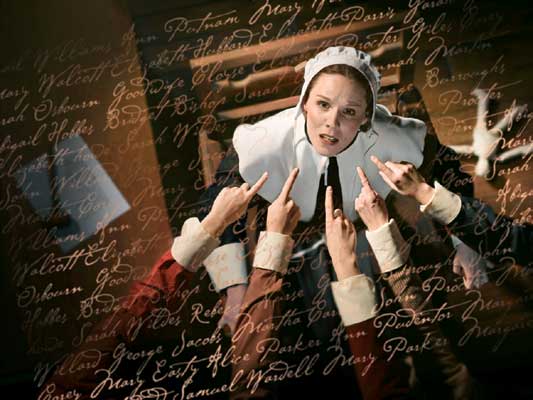
The Crucible by Arthur Miller Themes and Message of Author

This resource is for Mainstream English students studying the play ‘The Crucible’ by Arthur Miller in the Victorian Curriculum.

  • Vengeful Community & Suffering

Salem contributes to their own destruction through a toxic combination of fear, intolerance, and a desire to find scapegoats.  Message of Miller = The text argues that the greatest threat to a community can come from within when people reject rationality and become victims of their own blind prejudices.  Widespread belief in the active malevolence of the Devil underpins the mayhem that is unleased in Salem.  The desire to lay blame is strong and the poor and marginalised are obvious scapegoats in this God-fearing community.  Driven by jealousy Abigail manipulates the town’s fear and superstition in her personal vendetta against Elizabeth Proctor.  The erroneous assumption that the Devil is loose in Salem is exploited by unscrupulous individuals whose wickedness and greed are all too recognisably human.

  • Judgement and persecution (closely connected to guilt)

Message of Miller = The text explores the relationship between judgement, punishment, and forgiveness and how the judgement of others impacts upon individual’s reputations and sense of self-worth which is punishment in itself.  At the end of Act 4, John Proctor arrives at an impossible impasse—save himself through false testimony and damn his friends, or be executed alongside them. He seeks Elizabeth’s counsel and blessing, but she attests ‘I cannot judge you …’ (p. 120). The burden of the moral decision rests with John, just as he must bear the consequences of his final actions.

  • Guilt

Message of Miller = He is interested in the way in which good men can be persuaded to doubt themselves and how damaging the effects of guilt can be and the corrosive effects of guilt.  John Proctor judge himself harshly and has a sense of unworthiness makes him complicit in the retribution demanded of him.  Hale blames himself for his role in the witch hunt and his crisis of conscious pitches him against the court of which he was a crucial part.  Danforth is so convinced of Salem’s guilt that even the news of Abigail’s defection fails to weaken his resolve.

  • Hysteria

Message of Miller = The text argues that the greatest threat to a community can come from within.  The social compact, including respect, goodwill and shared history, is irreparably damaged when people reject rationality and become victims of their own blind prejudices and hysteria. There are many examples of hysteria within The Crucible. Wild accusations, violence and absurdist behaviour erupts in an ever-growing climate of fear. Modern readers recognise the power of suggestion and mob mentality at work in the girls’ frenzied behaviour in the courtroom, their ability to turn cold, and to faint. However, this is interpreted by the Judges as weighty evidence in support of the notion that the devil is alive in Salem. Act 3 provides one of the most dramatic examples, perhaps because the tension and fear has become so palpable. Mary Warren has presented her deposition and the news of John’s lechery is brought to light. There is a real chance that both Abigail and John will ‘slide together’ into the moral pit of their own doing, the court proceedings exposed as farce.

  • Love & Forgiveness

Message of Miller = The Crucible demonstrates how closely love is allied with forgiveness.  The Proctor’s love each other deeply but Proctor’s adultery has damaged the couple’s marriage.  Act 2 reveals how strained relations between them have become as Elizabeth tells herself that she has forgiven her husband but still an ‘everlasting funeral’ (p.55) marches around her heart.  Arthur Miller explores the tortured soul of John Proctor.  His immense guilt and attempts to earn back the trust and forgiveness of Elizabeth form an essential component of his tragic state, and without these traits the audience would not feel so much for him by the end of the final Act 4. For a long time, it is clear that Elizabeth cannot forgive John. He becomes enraged after her suspicious questioning, remarking that ‘an everlasting funeral marches round your heart.’ (p. 55). The imagery of her solemn and dark heart reveals that John has injured his wife deeply and that forgiveness is not easily given. Through the adversity they face, each gains a new perspective and, in their final conversation, both seek to repair their broken bond and ask forgiveness.  Therefore, love is presented as a powerful force for good, challenging the bigotry and hatred that threatens to overwhelm events.

  • Revenge and shifting power

Message of Miller = The text reveals a shift within the power structures that have historically held strong in Salem.  Those who held absolute power at the start of the play now find themselves doubted by the community. Hale still maintains his role as an advisor, but now he is a ‘broken minister’ and asks fellow Christians to belie themselves. Hale urges Danforth to postpone the execution warning of rebellion in Andover. Judge Danforth’s reluctance to admit wrongdoing only succeeds to further unloosen his final grip on power. The society of Salem is fated for annihilation at the hands of vengeance.

  • Abuse of Power

Message of Miller = Power and the abuse of it is in the text as the patriarchal society meant men-controlled society and could abuse their wives with impunity.  However, in Salem the concept of female empowerment was alien, yet Abigail is instrumental in shaping the crisis that plays out in the town.  The power she exercises in malevolent and self-interested.  Her intimidation of the girls demonstrates the force of her personality and the strange hold she develops over them.  The witch-hunt gives her status and influence and even the judges believe her every accusation no matter how far-fetched.  Danforth and Hathorne represent the highest power in the province, and his authority is corrupted on a grand scale rigid in believes and self-serving in his priorities, he rules by fear and embodies the face of the public fear unleashed in Salem.  In a perverse rationalisation, he refuses to pardon the condemned prisoners on the basis that 12 have already been hanged for the same crime.  His own reputation and that of the government he represents, is more important that the lives of the innocent people he convicts.

  • Outcasts, Hypocrisy, Memories & the Past

Message of Miller = The text focus is on the plight of the outcast and the way they are made scapegoats.  Tituba is an outcast in Salem, as a woman from Barbados, and as a slave. She is the property of Reverend Parris and her background sets her apart from the Puritan faith. She is powerless and, unsurprisingly, is the first to be accused as a witch. Tituba faces the impossible decision to falsely confess, or be hanged. She acts on survival instinct.  Tituba’s cooperation with Reverend Hale not only raises her low social status, it enables her to finally express her feelings towards her master, ‘mean man’ Reverend Parris. Tituba shocks the congregation by saying the Devil, ‘he bid me rise out of my bed and cut your throat’ (p. 48), revealing her repressed anger and feelings of helplessness.

  • Secrets, Hypocrisy & Conformity

In the town of Salem, we see a pretence born from an intense social pressure to conform, coupled with the fear of others’ retribution. Proctor’s words “common vengeance writes the law” reveal that the townsfolk have always harboured feelings of resentment towards one another. They have also always known each other’s business, yet stood mute. This is illustrated when Mary Warren bashfully admits to John that she knew of his affair— ‘I have known it sir’ (p. 74). Message of Miller = The witch trials provide an outlet for people to unburden themselves of the repressed feelings that accompany long-held grudges. Even those with little power, such as children, could suddenly assert their power, metaphorically possessing the keys to heaven and wreaking cruel vengeance on anyone who had wronged them in the past.

  • Truth, Deception, Illusion, Hypocrisy, Memories, the Past is too full of Pain

Message of Miller = In The Crucible, there is a disconnect between what people are ready to believe about themselves and the world around them, and what is actually true.  Truth is an expendable commodity in this community.  Abigail’s fundamental contempt for Salem’s hypocrisy is one of the factors that enables her to rationalise her outrageous lies.  In setting her terrifying fraud in motion, ignorance and the prevailing religious ethos play into her hands.

Sarah Good is an outcast in the community and is one of the first to be used as a scapegoat during the first frenzied accusations. This final remark from Sarah Good is quite beautiful, evoking imagery of freedom and transformation in death. We see the same camaraderie between Sarah Good and Tituba in this scene. The women within The Crucible also avoid the topic of their impending fate. Tituba says ‘we goin to Barbados soon’ and there ‘him be pleasure man’, ‘singin’ and dancin’ (p. 108). The two women, bound by their shared persecution and exile, console themselves with the image of flying southerly towards a brighter future.

  • Suffering has an impact on mental state

Ann Putnam suffers the fate of mourning the loss of her babies in the public arena of Salem. She is bitterly envious of women, such as Rebecca Nurse, who have been blessed with fruitful families. This jealousy turns to rage when Rebecca Nurse chastises her about her immoral behaviour. Message of Miller = The character of Ann Putnam once again highlights the power of grief. Even the fear of God’s wrath is not enough to stop her from sending her only daughter Ruth to conjure the spirits of her lost babes.

  • Acceptance and forgiveness

Message of Miller = John Proctor speaks of the exact compassion and selflessness.  Proctor has the option to save himself, yet he considers the impact of this decision upon other people. He recognises that tragedy does indeed include everyone, and he is not willing to ‘blacken’ the names of his friends and set an example of deceit to his sons. John Proctor is a respected pillar within his community and his and his friends’ death represents a critical moment in terms of dismantling an archaic system of judgement.

  • Vengeance & Motif of Fire is a Powerful Symbol

The motif of fire is a powerful symbol employed by Miller. John Proctor tells Danforth that they will ‘burn together’ as payment for their cowardice. John accuses Danforth of being too afraid to stand against evil, like the brave Malcolm and Macduff were able to do. One of Miller’s central messages = is that we must oppose injustice in the world and work to keep powerful institutions accountable. In fact, the final scene where Proctor, Martha Corey and Rebecca Nurse are executed occurs at the beginning of a new day. Elizabeth’s final comment ‘he have his goodness now’ (p.126) is uttered as ‘the sun is pouring upon her face’, symbolic of a new dawn where goodness has prevailed.
All Resources created by englishtutorlessons.com.au Online Tutoring using Zoom for Mainstream English Students in the Victorian VCE Curriculum

Oedipus the King Play by Sophocles Brief Overview

This Resource is for Year 12 students studying Sophocles ‘Oedipus the King’ in the VCE Victorian Curriculum for Unit 3 AOS1 Reading and Responding to Texts.

Author

Sophocles leading dramatist in Greek classical period 500-323 BC

Year Performed

430 BC at the festival of Dionysia

Type & Genre

Greek tragedy play – like an ancient murder mystery

Perspective

Greek audience came to watch the play to learn about life through what happens to Oedipus and his fate

Title

In the original Greek, Sophocles’ play was entitled ‘Oidipous Tyrannos’; once the play was translated to Latin, it became ‘Oedipus Rex’, and then in English, ‘Oedipus the King’. The original title aptly included the term ‘tyrannos’, meaning a king with no legitimate claim to the throne, a nod to Oedipus’ belief that he is not descended from Cadmus’ lineage.

Structure of a Greek Tragedy

Peripeteia = A tragedy must have some kind of reversal of fortune – the fall of the tragic hero – Oedipus experiences a peripeteia after the Messenger from Corinth sets off the chain of events that leads to his destruction.

Anagnorisis = The recognition scene when the tragic hero becomes aware of their reversal. Oedipus anagnorisis occurs when he realises that he is the lost son of Laius and Jocasta.

Hamartia = Known as the tragic flaw where heroes have a frailty or make some kind of error that leads to their downfall.

Catharsis = The goal is to create catharsis in the audience to evoke both horror and pity.

Brief Overview of ‘Oedipus the King’

‘Oedipus the King’ written by Sophocles for the Great Dionysia celebration, is a Greek tragedy that is read like a kind of ancient murder mystery. The play is regarded as a classic example of the ‘tragedy of fate’. The hero of the play is his own destroyer, he is the detective who tracks down and identifies the criminal, who turns out to be himself. It is the story of a great but flawed man, doomed to perform the most heinous crimes, despite doing everything he thinks he can to prevent the hideous web that fate has spun for him. The play tells the story of Oedipus, ruler of Thebes who discovers on a terrible day that he is the lost son of the previous king, his father Laius, and his wife Jocasta. This leads to a chain of tragic events that is unveiled as Oedipus unwittingly killed his father (parricide – murder of a parent by a child) and married his mother (incest – sexual relationship of son with mother). Written over 2000 years ago, suggests that fate is determined and the gods have active roles in people’s lives. These ideas were commonly accepted in Sophocles time but are not widely accepted now. Oedipus gradual realisation of his fate, and of the terrible crimes he has unknowingly committed, might be considered impossible or implausible to modern society. However, in the world of ancient Greece, it is possible to see Oedipus determined quest to uncover the truth for the sake of his city Thebes and his deep remorse for the errors of his past, as very recognisable and sympathetic qualities. The action of the play occurs many years after the horrible events, on the fateful day when the truth behind them comes to light.

Timeline of Events Oedipus the King

LinesEvents
1-85The priest, talking with Oedipus, tells him Thebes is under a curse and the city needs his help again.
86-150Creon learns from Apollo that the curse on Thebes resulted from King Laius’ murder. The city must banish the murderer to lift the curse.
151-215The Chorus calls on various Olympians to aid Thebes.
216-275Oedipus asks the Thebans to help him find and expel Laius’ murderer. He avidly begins an all-out manhunt.
276-379The blind priest Tiresias has information about the plague, which he refuses to divulge. After much prodding from Oedipus, Tiresias claims that Oedipus is the source of the curse.
380-461Oedipus alleges that Creon and Tiresias are conspiring against him. Tiresias tells Oedipus to learn the truth about his parents and then forecasts Oedipus’ downfall.
462-531Creon, talking with the Chorus, denies the charges of collusion with Tiresias.
532-633Oedipus threatens to execute or deport Creon. Creon maintains his innocence and advises Oedipus to consult Apollo.
634-678Oedipus’ wife, Jocasta, and the Chorus defend Creon and convince Oedipus not to kill or banish him.
679-725Oedipus explains Tiresias’ prophecy to Jocasta; Jocasta counters that not all of Apollo’s vision come true and cites King Laius as an example.
726-770Jocasta recounts Laius’ murder. Oedipus has the first suspicions that he may have killed Laius.
771-863Oedipus tells about the group of travellers he murdered. Oedipus demands to see the lone survivor of the group to confirm if he indeed killed Laius.
864-910Chorus calls on the gods for help.
911-974A messenger tells Oedipus that the King of Corinth is dead and that Oedipus is to assume the throne. Oedipus refuses to return, for fear of fulfilling Apollo’s prophecy that Oedipus would sleep with his mother.
975-1076Messenger tells Oedipus that he is not, in fact, the son of Polybus (the dead King of Corinth): A herdsman rescued Oedipus, after he was exposed as an infant, and turned the baby Oedipus over to the messenger himself. Jocasta becomes convinced that Oedipus murdered Laius.
1077-1185Oedipus brings in the herdsman who rescued him as a child. Oedipus squeezes the information out of the herdsman and realizes that he is the son of Laius and Jocasta, killed his father (Laius) and slept with his mother (Jocasta).
1186-1297Long lament by the Chorus. A second messenger reports Jocasta’s suicide.
1298-1422Oedipus blinds himself. Oedipus claims he will suffer more by blinding himself than by suicide.
1423-1475Oedipus asks Creon to banish him from Thebes and administer rites to Jocasta.
1476-1515Oedipus laments for his daughters, Antigone and Ismene.
1516-1530Conclusion. Chorus indicates that Oedipus will continue to live after the tragedy’s ending.

Brief Character Analysis

Oedipus

At the beginning of the play, the eponymous character believes himself to be the son of Polybus and Merope, the King and Queen of Corinth. Oedipus had been granted the throne of Thebes because of his ingenuity in defeating the Sphinx, who had cursed Thebes and was terrorising its citizens. An additional part of Oedipus’ reward was marriage to Jocasta, the widowed wife of the former king, Laius. Unbeknownst to Oedipus, he has married his biological mother, having previously murdered Laius on a road far outside Thebes, not realising that Laius was the King of Thebes, nor that Laius was his biological father.

Most aspects of his character revolve around the question: to what extent is Oedipus guilty of the fate that befalls him? He has a wide range of personality traits both positive – bravery & cunning. But he also has negative traits – hubris (pride), foolish, naïve, hot tempered, authoritarian, paranoid, lacks insight into his faults, denies the truth. By the end of the play his traits have changed to be more humble even though blinded he sees the truth more clearly.

Jocasta

Oedipus’ wife (and unknowingly his mother) does not enter the play until the conflict between Oedipus and Creon is well underway. She is immediately presented to the audience as a confident woman and one whom the people respect. As Queen of Thebes she was married to King Laius and is the mother of Oedipus whom she had abandoned on Mount Cithaeron when he was three days old. She becomes the unwitting wife of her own son not long after the death of her husband and bears Oedipus 4 children – 2 sons Eteocles and Polyneices and 2 daughters Antigone and Ismene.

Aspects of her character revolve around the question: how could a mother abandon her own newborn child? She appears a jaded person haunted by fate and her past. The audience and the Chorus share sympathy with her horror of realising the terrible outcome of her past and the consequences of marrying her own son. At the end of the play Jocasta suicides because she cannot live with herself, but also because, as a woman, she cannot live within society.

Creon

Creon is Jocasta’s brother and at the start of the play Oedipus brother-in-law but also his uncle. Creon is respected by the people of Thebes and is initially regarded by Oedipus as a loyal and trusted friend. Despite their relationship souring, and Oedipus even viewing Creon as the antagonist at times, he is in fact the hero of this tale. He shares Oedipus’ desire to save Thebes from destruction and is equally determined to search for the truth behind the oracle.

Positive aspects of his character are held up by Sophocles as the man we should aspire to be: steadfast without stubbornness, confident without arrogance. He even bears the quality most commonly regarded as being essential for a good king: he does not want to be one. Where Oedipus is aggressive and headstrong, Creon is reasoned, temperate, cautious and content with his position of not being king with all the worries.

Tiresias

The character of Tiresias, whose name literally means ‘portent’, was included in many Ancient Greek myths and tragedies. He is revered by the Thebans, who refer to him as ‘Lord Tiresias’ and claim he ‘sees with the eyes of Lord Apollo’ [323]. Despite the esteem in which he is held by the Chorus, Tiresias’ role in Oedipus the King is a tragic one. He unwillingly comes to Thebes at Oedipus’ behest, and endeavours to conceal his knowledge, because he knows ‘the truth is only pain to him who sees’ [360]. He is threatened and taunted by Oedipus, who not only is ignorant of the knowledge Tiresias holds, but also unaware of the kindness Tiresias attempts to show Oedipus in bearing the burden of being the one in whom ‘the truth lives … [in] him alone’ [339].

The Priest

The Priest of Thebes plays an important role within his community, as well as in this play, as it is his treatment of Oedipus that sets the tone for Sophocles’ interpretation of the mythological character of Oedipus. While Oedipus presents himself as a god among men when he questions why the Chorus is ‘pray[ing] to the gods’ when he will ‘grant [their] prayers’ [245], the Priest identifies Oedipus as the ‘first of men’ [41], and he has already clearly stated that Oedipus ‘cannot equal the gods’ [39]. The Priest’s distinction between the gods and men (even the ‘first of men’) challenges Oedipus to step back from his hubris, however, Oedipus responds to the Priest’s words with excessive references to himself and all he feels and all he has done.

While the Priest’s role seems to be that of a grounding agent, persistently reminding Oedipus of his status, and that even in Oedipus’ greatest triumph ‘a god was with [him]’ [48], there are inconsistencies that feed into Oedipus’ sense of grandeur and blur the line between respect for a king and worship of a god.

The Chorus

As a standard in Greek drama the Chorus have a double identity – one within the plot and one outside of it. The Chorus in the plot identity is as a group of Theban citizens to fulfill duties of answering questions about characters and events and as an intermediary between characters. The outside the plot role is to comment on social, religious and historical meaning of the unfolding action of the play.

THEMES
fate versus free will & prophecywisdomblindness figurative versus literal
choice & freedomcost of ignorance & value of knowledgemorality & the good life
truthpower & tyranny as rulerhubris (pride)
banishment & exileidentityfamily
determinationself-discovery 
SYMBOLS & METAPHORS
truths & half truthsblindnesseyes & vision
hearing & listeningnauticallight & dark
swollen ankles & feetthe cross roadsthe oracle

All Resources created by englishtutorlessons.com.au Online Tutoring using Zoom for Mainstream English Students in the Victorian Curriculum

Oedipus the King by Sophocles Key Themes and Quotes

This Resource on Key Themes and Quotes in the play ‘Oedipus the King’ by Sophocles is for Year 12 Students studying in the Victorian VCE Curriculum.

Fate vs Free Will / Prophecy

The play is known as a tragedy of destiny – its tragic effect is said to lie in the contrast between the supreme will of the gods and the vain attempts of mankind to escape the evil that threatens them. The lesson is to learn from the tragedy – submission to the divine will and realisation of his own impotence [powerlessness].

The play hinges on two prophecies. The first is the prophecy received by King Laius of Thebes that he would have a son by Queen Jocasta who would grow up to kill his own father. The second is the prophecy that Oedipus received that he would kill his father and marry his mother. Laius, Jocasta, and Oedipus all work to prevent the prophecies from coming to pass, but their efforts to thwart the prophecies are what actually bring the prophecies to completion.

This raises a question at the heart of the play: does Oedipus have any choice in the matter? He ends up killing his father and marrying his mother without knowing it? Does he have free will—the ability to choose his own path—or is everything in life predetermined?

Oedipus’s destruction comes not from his deeds themselves but from his persistent efforts to learn the truth, through which he reveals the true nature of those terrible deeds. Oedipus himself makes a different argument at the end of the play, when he says that his terrible deeds were fated, but that it was he alone who chose to blind himself. Here, Oedipus is arguing that while it is impossible to avoid one’s fate, how you respond to your fate is a matter of free will.

For the Chorus, prophecy is synonymous with the will and knowledge of the gods that “destiny will guide me”, although they do at times waver in this devotion under the influence of their loyalty to Oedipus.

Quotes

“This day will bring your birth and your destruction” (Tiresias line 499 p.184)

“An oracle came to Laius one fine day … and it declared / that doom would strike him down at the hands of a son / our son, to be born of our own flesh and blood” (Jocasta lines 784-8 p.201)

“Apollo was explicit: my son was doomed to kill my husband … my son, poor defenceless thing, he never had a chance to kill his father. They destroyed him first” (Jocasta lines 944-7 p.208)

“It’s all chance / chance rules our lives. Not a man on earth / can see a day ahead, groping through the dark / Better to live at random, best we can” (Jocasta lines 1069-72 p.215)

“I count myself the son of Chance / the greatest goddess” (Oedipus lines 1188-9 p.224)

“Destiny guide me always / Destiny find me filled with reverence pure in word and deed” (Chorus lines 954–956 p.209)

Sight vs Blindness

Oedipus lack of wisdom is highlighted by the central idea of blindness. When Oedipus publicly declares his intention to solve the mystery of King Laius’s murder like a determined detective seeking the truth, he says, “I’ll start again—I’ll bring it all to light myself” but his overarching pride is his true blind spot. Oedipus’s vision and intelligence have made him a great king of Thebes—he solved the riddle of the Sphinx and revitalized the city. But he is blind to the truth about his own life and cannot see the truth clearly.

Ironically it takes the blind prophet, Tiresias, to point out his ignorance and to plant the first seeds of doubt in Oedipus’s mind. Tiresias first informs him of his fate by speaking in riddles. He tells Oedipus: ”Eyes hast though, but thy deeds thou canst not see.” In this, Tiresias tells Oedipus is blind even though he may have working eyes. He then warns him that this will not always be the case, when he says, ”in thine eyes now light, but then darkness.”

Oedipus responds to Tiresias’ riddles with anger. He asks the prophet to speak plainly. When Oedipus mocks Tiresias’s blindness, Tiresias predicts that Oedipus himself will soon be blind and beggared, which comes true by the end of the play. Indeed, when Oedipus learns the full story—that he has killed his father and married his mother—he gouges out his eyes. He learns the nature of fate and the power of the gods, but at a great cost. Although he is blinded, he has learned to see something he could not see before (or perhaps chose not to see). He also asks to be exiled, eventually becoming a beggar.

Quotes

“I’ll start again—I’ll bring it all to light myself” (Oedipus line 150 p.167)

“You’ve lost your power, stone blind, stone death – senses, eyes blind as stone” (Oedipus lines 423-4 p.181)

“Blind, who now has eyes, beggar who now is rich, he will grope his way toward a foreign soil, a stick tapping before him step by step” (Tiresias lines 516-19 p.185)

“Not a man on earth can see a day ahead, groping through the dark. Better to live at random, best we can” (Jocasta lines 1070-1 p.215)

“What good were eyes to me? Nothing I could see bring me joy” (Oedipus lines 1472-3 p.241)

Truth

In his search for the truth Oedipus is engaged in a great calculation, to determine the measure of a man. However, the terrible deeds that are Oedipus’s undoing actually took place long before the play begins. King Laius has been dead for many years, Oedipus has ruled for some time, and his marriage to Jocasta has produced four children. They might have all remained happy in their ignorance had the plague not come to Thebes and the oracle not commanded that the murderer of Laius be found. Good king that he is, Oedipus swears he will find the murderer. Every step of the way, people are reluctant to speak and try to tell him that it would be better if the past were left alone. Creon suggests that they discuss the oracle behind closed doors, not in front of everyone, but Oedipus wants to show that he is open to the truth and keeps no secrets from his people.

Tiresias refuses to say what he knows, and only speaks when he has been insulted and accused of treachery. Jocasta begs Oedipus to cease his investigations. The old shepherd gives Oedipus the final pieces of the puzzle only when threatened with death. In his desire to seek out the truth and save his people from the plague, Oedipus becomes his own prosecutor, and then his own judge and punisher.

Oedipus is a free agent, by his own self-willed action he discovers that his own predicted destiny has already been fulfilled. His heroic achievement is the discovery of the truth about the prophecies, about the gods and about himself regardless of disaster.

Quotes

“Lord Tiresias sees with the eyes of Lord Apollo / Anyone searching for the truth, my king, might learn it from the prophet, clear as day” (Chorus Leader lines 323-5 p.174)

“How terrible to see the truth when the truth is only pain to him who sees” (Tiresias lines 359-60 p.176)

Identity & Self-Discovery

In the play the consultation of oracles is strongly associated with the search for a character’s identity. All the characters in the play who seek the truth about themselves through the word of oracles – Laius, Jocasta and Oedipus – come to bad ends. Those characters who seek the truth about their fates and then once received the prophecy they go about trying to alter their fates. Sophocles is telling us that those people who try to alter their fates do so and court catastrophe.

Truth about his identity is the reason Oedipus consults the oracle in the first place after a drunken reveller at one of Polybus’ banquets accuses him of not being the king’s natural son. When the oracle offers a prophecy “you will kill your father and couple with your mother” Oedipus knows that he is the man who will do those deeds and it changes everything about him, marking him, from that moment on, with a new identity.

Before Oedipus learns his identity, he was – son of Polybus, husband of Jocasta, foreign to Thebes, savour of Thebes, King of Thebes and ‘tyrannos’ (signifies the throne was not gained through an inheritance). After he learns his identity, he is revealed to be – son of Laius, son of Jocasta, native to Thebes, scourge of Thebes, outcast and a ‘man of agony’.

“Count no man happy till he dies” by the Chorus is a theme that leads to self-discovery which suggests a causal link between Oedipus rise and his fall. The road to self-discovery adopted by Oedipus leads him to his downfall and tragic end. Oedipus knows the answers to the Sphinx riddles but does not know his past. Despite his popularity, knowledge and tireless efforts to make his kingdom safe. Oedipus, eventually falls in the pit of disgrace and discovers that he was just a pawn in the hands of nature or gods.

Quotes

“Here I am myself / you all know me, the world knows my fame / I am Oedipus” (Oedipus lines 7-9 p.159)

“I stand revealed at last / cursed in my birth, cursed in marriage / cursed in the lives I cut down with these hands” (Oedipus lines 1308-10 p.232)

“Count no man happy till he dies” (Chorus line 1684 p.251)

Cost of Ignorance & Value of Knowledge

Inscribed upon the pediment at Delphi was the maxim ‘Know thyself’. Sophocles definitively utilises the myth of Oedipus to chastise ignorance, but he also wants his audience to look inward: In what ways are we acting without the appropriate awareness? How can we become more aware in order to lead a better life?

Through his depiction of the character Oedipus, Sophocles criticises ignorance and celebrates awareness, especially self-awareness. Sophocles uses the events of the play to castigate Oedipus, and anyone else who would let themselves fall victim to such a fatal flaw. When Oedipus refers to himself as ‘ignorant’ [451], he believes he is being ironic, however, Sophocles includes this line to reinforce the degree to which Oedipus is truly ignorant. The play also emphasises how Oedipus’ arrogance feeds his ignorance (and vice versa). This is seen in his recollection of his greatest triumph: ‘I came by, Oedipus the ignorant, I stopped the Sphinx … the flight of my own intelligence hit the mark’ [450–453]. Sophocles’ heavy use of dramatic irony and characterisation of Oedipus as impulsive and falsely confident in his wit, ensures a stark contrast with the truth; that every choice Oedipus makes is marked by his ignorance, by what he does not know, or refuses to see.

Although much of the plot focuses on the ignorance of Oedipus, he is not the only character to sacrifice knowledge because of naivete. The Chorus grapple with a choice: the decision to ignore Tiresias, or to choose treason against Oedipus. Jocasta, too, is not only guilty of ignorance, but also of the greater sin of choosing ignorance. When Oedipus is on the cusp of learning the truth, Jocasta urges him (and herself), ‘don’t even think—’ [1159]. When this first attempt fails, Jocasta calls for Oedipus to ‘stop— in the name of god’ [1163]. The truth has dawned on her, and she is afraid. It is Creon, once again, who acts as a model for Sophocles’ values. In his argument with Oedipus, Creon uses logic, not insults and bias, to point out that the oracle he reported from Delphi can be easily confirmed. Then, when confronted with a statement he cannot explain, he simply states: ‘I don’t know. And when I don’t, I keep quiet.’ [635]

Quotes

“I came by, Oedipus the ignorant, I stopped the Sphinx … the flight of my own intelligence hit the mark” (Oedipus lines 450-53 p.182)

“Can’t accept him [Tiresias], can’t deny him, don’t know what to say (Chorus line 551 p.187)

They “Saw [Oedipus] then … saw with our own eyes his skill, his brilliant triumph—” against the Sphinx (Chorus lines 569–570 p.187)

Don’t give it another thought, don’t even think” (Jocasta line 1159 p.222)

“Stop— in the name of god, if you love your own life, call off this search” (Jocasta line 1163-4 p.222)

“I don’t know. And when I don’t, I keep quiet” (Creon line 635 p.191)

Morality & The Good Life

Sophocles uses the character of Oedipus to explore the notion that one may have many admirable qualities, however, the subject ought not to balance the scales in favour of believing oneself capable of ‘grant[ing] prayers’ [245] meant for the gods.

Likewise, Sophocles holds Creon up as an example of a man capable of living a good life. He is flawed, but those flaws do not prevent him from living a life of pious respect and moderation. Creon recognises the good life he is already living, and when Oedipus’ downfall increases Creon’s power, the man who claimed to not ‘yearn for kingship’ [657] is consistent in that resolve; he does not ‘come to mock … Oedipus’ [1557], but quietly accepts his new role without long speeches or hasty decrees. Creon recognises the good in living a life where ‘all men sing [his] praises, all salute [him]’ [668] and questions ‘who in his right mind would rather rule and live in anxiety than sleep in peace?’ [654–655].

Sophocles uses frequent metaphors and allusions around sight and listening to show that Oedipus’ main moral sin is his lack of awareness. He murders without knowing who he murders, he marries without knowing whom he marries, and he acts with unbridled arrogance without acknowledging his place in the hierarchy of god and mortals.

Quotes

“You pray to the gods? Let me grant your prayers” (Oedipus line 245 p.171)

“Now all men sing my praises, all salute me” (Creon line 668 p.193)

“Who in his right mind would rather rule and live in anxiety than sleep in peace? (Creon lines 654–655 p.193)

Hubris (Pride)

Hubris (pride) is a favourite trait in Greek tragic heroes. It is clear that Oedipus has a wide range of personality traits both positive and negative. He exercised two of his best qualities – bravery and cunning to answer the riddle of the Sphinx. However, being impetuous he suffers from hubris, pride in himself, his skills and intelligence as a ruler, a detective, his ability to defy Apollo and fate. It was his pride that led him to believe he was above the will of the gods and destiny. It was his pride and hot temper that led him to kill Laius at the cross-roads. It was his pride that led him to bring curses down on an unknown culprit. He accused the blind seer Tiresias and his trusted brother-in-law Creon and friend of treachery. His fatal flaw of pride led him down to the path in search of a truth that he ought to have never learned.

Quotes

“Here I am myself – you all know me, the world knows my fame / I am Oedipus” (Oedipus lines 7-9 p.159)

“I’ll start again—I’ll bring it all to light myself” (Oedipus line 150 p.167)

“Pride breeds the tyrant / violent pride, gorging, crammed to bursting” (Chorus lines 964-5 p.209)

Family

The theme of family is central as the driving events are Oedipus crimes of parricide and incest. Murdering one’s father and coupling with one’s mother is the worst crimes a man can commit in the family sphere and there are morals and ethics involved. Incest with one’s mother is a crime against nature as it is likely to result in children weakened by genetics.

Sophocles criticises Laius and Jocasta regarding disposing of their son and even the shepherd charged to get rid of the baby disobeys because he “pitied the little baby” (line 1301 p.232). Polybus of Corinth adopts the baby and is described as having “loved [him] deeply” (line 1121 p.219). The crime committed by Laius and Jocasta against the natural order to kill their first-born son and then engender no further heir is a profound political crime as well as social/family crime.

For all his faults Oedipus is a family man who will make almost any sacrifice not to hurt those he calls his own. Comparisons can also be made of family love at the end of the play with Oedipus scene of lament as he weeps about the future of his daughters Antigone and Ismene which is the opposite to Jocasta handing over her newborn son to a terrible death.

Quotes

“You were a gift” (Messenger line 1117 p.218)

“Then how could he love me so? He loved me, deeply” (Oedipus line 1121 p.219).

“But still / to see one’s parents and look into their eyes / is the greatest joy I know” (Oedipus lines 1094-6 p.216)

“Her own child / how could she” (Oedipus lines 1294-5 p.231)

“But my two daughters, my poor helpless girls … Take care of them/ I beg you” (Oedipus lines 1602-6 p.247)

“How I weep for you / I cannot see you now / just thinking of all your days to come, the bitterness, the life that rough mankind will thrust upon you” (Oedipus lines 1627-29 p.248)

Banishment & Exile

Types of banishment, whether physical or emotional flow from each of the 2 prophecies for Oedipus – the one received by Laius that he would be killed by his son and the other received by Oedipus himself that he would murder his father and mate with his mother. Oedipus decrees early in the play that the murderer of Laius will be banished from Thebes.

The first banishment occurs to Oedipus when he is only 3 days old and the callousness his parents exhibit towards their own child is emotional exile from the normal love and care and a home. The next banishment occurs when Oedipus leaves Corinth believing that to stay would mean murdering Polybus and sleeping with Merope. This exile is from a warm family environment and emotional torment means Oedipus will not see his adopted parents again. His third banishment is from Thebes where it has been established, he was the one who murdered Laius. The fourth banishment is worse when he realises, he definitely has murdered his father and mated with his mother he puts out his eyes and resolves to remove himself from the sight of all people. This is self-exile but from the human race where he requests an exile to Mount Cithaeron, the scene of his exile as a baby.

Quotes

“I order you, every citizen of the state / where I hold throne and power: banish this man … Drive him out, each of you, from every home / He is the plague, the heart of our corruption / as Apollo’s oracle has just revealed to me” (Oedipus lines 269-77 p.172)

“Drive me out of the land at once, far from sight / where I can never hear a human voice” (Oedipus lines 1571-2 p.245)

“Drive me out of Thebes, in exile” (Oedipus line 1667 p.250)

Power & Authority

Throughout the play, Sophocles explores questions around authority. In particular, he examines closely the dilemmas raised by competing obligations to the law, to one’s community, as well as to the gods, and to religion. Over the course of the play, the characters’ perspectives on authority and loyalty shift. The Priest attempts to set a standard, a measure by which citizens can sequence their obligations: ‘Now we pray to you. You cannot equal the gods, your children know that … But we do rate you first of men’ [39–41]. Through his evocation of the conflict experienced by the Chorus, Sophocles suggests that one should ideally never feel conflicted by the competing obligations to heavenly leaders and earthly ones, and that it is the responsibility of the earthly leaders to ensure their citizens are never placed in such a predicament.

At several points in the play, the Leader and the Chorus find themselves in difficult situations where they not only have to choose between their faith and their loyalty to Oedipus, but they also essentially need to lead Oedipus. The Leader confirms their role in society to Creon and their shrewd political instincts not to side with anyone, they ‘never look to judge the ones in power.’ [592–593]. Furthermore, Oedipus has a responsibility to his people to ‘steer [them] through the storm’ [767], not act the petulant child who needs to be coerced into behaving with the temperance of a good king.

However, is not Oedipus’ way. ‘No matter’ he asserts, ‘I must rule.’ [703]. This line shows a value shift in Oedipus; he sees maintaining control as more important than being right. Sophocles punishes Oedipus for this view, and again holds Creon up as an example of good leadership when he responds ‘Not if you rule unjustly’ [703]. Creon here asserts his view of the responsibility of leadership.

By the end of the play, the Chorus realise their faith in Oedipus was misplaced, and they rephrase their commitment, having learnt from the events before them: ‘god, my champion, I will never let you go’ [971]. And thus, Sophocles’ message to his audience, to dedicate oneself to the gods and have trust in their authority over all else, is underscored. It is possible to argue that the play is also subtly delivering a message to those with power that they should never compromise themselves or their citizens by creating a contradiction in obligation when it comes to the need to pay service to the gods and to society.

Quotes

“Now we pray to you. You cannot equal the gods, your children know that … But we do rate you first of men” The Priest lines 39–41 p.161)

“I never look to judge the ones in power” Chorus Leader lines 592–593 p.189)

“Now again, good helmsman, steer us through the storm” (Chorus line 767 p.199)

“No matter’ he asserts, ‘I must rule.’ (Oedipus line 703 p.195)

“Not if you rule unjustly” (Creon line 703 p.195)

“God, my champion, I will never let you go” (Chorus line 971 p.209)

All Resources created by englishtutorlessons.com.au Online Tutoring using Zoom for Mainstream English Students in the Victorian VCE Curriculum

Fear and Mass Hysteria in ‘The Crucible’ and Arthur Miller’s Views on the Play

Image result for Images of The Crucible

This resource is for Mainstream English students studying the play ‘The Crucible’ in the Victorian Curriculum.

Theme of Fear & Mass Hysteria

An important theme is that of fear and mass hysteria which leads to extreme acts in the play as the human inclination to ascribe blame for pain and suffering to others and then destroy the supposedly guilty party surfaces. In Salem the witch trials are a clear example of mass hysteria, with residents engulfed in a frenzy of accusations.

Context of Fear & Mass Hysteria in Salem

In ‘The Crucible’  Salem is a strict religious community where superstition is rife and scientific explanations minimal. In the puritanical colony of Massachusetts, reading books other than the Bible was forbidden, hence any scientific thinking was unlikely.

Mass hysteria and mob violence can infect the collective consciousness when fear, ignorance and isolation are not countered with universal education.  In Salem, personal vengeance, paranoia and fear, rather than grief and illness, is what escalates the social panic.

Miller writes that because ‘it is impossible for most men to conceive of a morality without sin’ Salem, and analogously his own 1950’s zeitgeist, was ‘gripped between two diametrically opposed absolutes.’ Such binary thinking and absolutism is another catalyst for mass panic or mob violence.

The society in Salem is spurred on to collective hysteria by a dualistic belief that things they don’t understand or can’t explain must be ‘evil’. Satan, when referred to in the Bible, is thought of as the evil one, the tempter, the wicked one. To the people of Salem, the Devil is the adversary of God and an invisible threat. But Miller’s audience sees that it is the villagers’ own inner demons that bubble to the surface and wreak havoc on the town, combined with their irrationality.

Martha Corey has done nothing particularly adversarial, she merely reads books that are not approved of by her neighbours, but she finds herself charged as a witch.

The end of Act One and Act Three of the play show just how infectious a group mentality can be. Close study of Miller’s acting directions in these two sections of the play reveals the range of causes for such a frenzy; whether that be characters offloading their own shame and resentment, or being so fearful of punishment that they will say anything to avoid it.

Briefly What is Causing Fear in The Crucible?

  • In ‘The Crucible’ Abigail and the group of girls spark fear in the town after being accused of engaging in sacrilegious activities while playing in the forest
  • The people in Salem are convinced that the Devil has arrived and must be driven from his conspirators
  • What begins with a handful of girls dancing in the forest manifests within eight days into a society whose feverish desire to rid itself of an unseen evil allows the suspending of human decency
  • Unfortunately fear leads to a rapidly growing series of accusations against various members of the community
  • Innocent people are labelled witches and forced to confess or suffer death

What does Miller Believe about the Spread of Fear?

  • Miller presents the witch hunt then as a consequence of the hysterical fear that grips citizens when faced with social and religious upheaval
  • Miller seeks not only to explore the evolution of mass hysteria but additionally to delve into what causes individuals to abandon personal loyalties in such times
  • Even justice and reason are sacrificed and religion, which should provide a moral and ethical blueprint, is used to fuel the emerging fear and hysteria
  • The theocratic society in Salem and the power of the state is under threat as individuals begin to question entrenched conservative, Puritan religious values
  • Miller explains this as a paradox as individuals seek greater freedom they become a threat to the religious and political status quo

Arthur Miller was interviewed about why he wrote ‘The Crucible’and his thoughts about fear, hysteria and the threat of the Devil in Salem.  See Arthur Miller’s views:

Fear Motivates People to Behave Unscrupulously in The Crucible

As Miller comments (on page 17 of the play in his notes before Act One), that “Old scores could be settled on a plane of heavenly combat between Lucifer and the Lord”.

  • Personal fears instigate some characters to cry witch
  • Reverend Parris fears losing his job provokes him to cry witch and if Abigail is exposed as the fraud she is he will be punished for supporting an illegitimate court procedure
  • Parris also fears that the rebellion in Andover about the hangings will occur similarly in Salem
  • Abigail uses fear of consorting with the Devil in her motives of vengeance against Elizabeth Proctor to accuse her of witchcraft
  • The group of girls do what Abigail says for fear of getting caught so deflecting blame away from themselves is their only option
  • The Putnams use fear and the hysteria of the accusations for self interest in acquiring land from those about to hang
  • Deputy Governor Danforth uses the fear as a reason for his agenda to protect his reputation, the court and the theocracy it serves

Mob Mentality, Punitive Justice & Binary Thinking

‘The Crucible’ is a legal drama. An entire scene takes place in the Salem meeting house which is now Judge Danforth’s court, but every scene in the play is concerned with the process of arriving at a legal judgement. Because the play is an analogy for Senator McCarthy’s HUAC hearings, the audience is positioned to regard the justice system of Salem as being similarly flawed and equally ideologically motivated. Justice is not delivered by this legal system.

Indeed, the audience is led to the conclusion that the most dangerous person in the play is Judge Danforth. His lack of mercy, his willingness to believe evidence that has no proof, and his preoccupation with his own reputation, all serve to remind Miller’s audience that justice denied anywhere diminishes justice everywhere.

In ‘The Crucible’, Elizabeth humbly tells her husband that she cannot judge him; ‘The magistrate sits in your heart that judges you. I never thought you but a good man, John’ (p. 55). Elizabeth believes in the supremacy of the individual’s conscience, of his own accountability for decisions and actions. Miller shows that only when John Proctor explores the depths of his own guilt can he begin the redemptive process.

At the end of the play he dies on his own terms and sees ‘some shred of goodness’ in his decision.  Proctor does not fear death because he has made his peace with himself and is free from self-admonition. His death is a great injustice, but the courage and moral conviction he shows is his legacy and his epitaph.

This Resources is created by englishtutorlessons with Online Tutoring of English using Zoom

Bad Dreams and Other Stories Essay Explores the Idea of Secrets

This Resource is for Year 12 students in the VCE English Curriculum studying ‘Bad Dreams and Other Stories’ by Tessa Hadley as a Text Response.

Essay Prompt: ‘Once the words were said aloud, she would never be rid of them; it was better to keep them hidden’. Quote the unnamed girl in ‘Bad Dreams’ story (p.116). “How does Hadley explore the idea of secrets in ‘Bad Dreams’?”

This essay uses a TEEL structure. Note – this essay is definitely too long with its word count, however, students can use it as a resource to create your own essay on ‘secrets’.

The Introduction is colour coded to help identify context of the issue, main contention and message of Hadley.

Introduction / Context / Main Contention / Message of Author

Secrets by nature create a barrier between people, preventing them from fully understanding and connecting with one another. The theme of secrecy and its destructive impact on relationships are central to many stories in Tessa Hadley’s collection Bad Dreams and Other Stories. Hadley illustrates how secrets can sometimes weigh heavily on the characters like a burden, performing a disciplinary function which characters conform to conventional ways of behaving. For others, the withholding of knowledge can yield a form of power or can preserve the privacy to explore one’s identity without the glare of scrutiny. Ultimately, Hadley offers a thought-provoking exploration of the destructive impact of secrecy on relationships and the need to find a balance between openness and privacy while navigating the complexities of trust and communication in relationships.

BP1 = Background / Who or what causes problems

(Topic Sentence) Characters often conceal truths from their loved ones in order to protect themselves. There is powerful symbolism in Hadley’s collection’s title ‘Bad Dreams’ which suggests various nightmares or simply unfulfilled dreams that characterise the experiences of the children and women in these stories. This is clear also in the epilogue to Swallows and Amazons created in the young girl’s own nightmare, symbolising the way in which women are disciplined into normative gender roles. The dualistic nature of secrets in the story kept by the unnamed girls thrills her. The sudden shift in perspective midway through the story draws attention to the paradoxical nature of secrets. Frightened by her nightmare and the horror or living to ‘a ripe old age’ like the ‘tame and sensible Susan’ (p.116), when she yearns to be the pirate girl Nancy, the girl tips over the lounge room furniture, a private moment of rebellion against the oppressive domesticity of her parent’s world, restoring a sense of control rocked by the implications of the nightmare. The vows to keep her nightmare from her parents as a secret that saying the words aloud would somehow render them more real, or that her fears would be dismissed by her parents – quote from the prompt. Hadley then uses a line break of 3 asterisk ellipses (p.120) to move over to the mother’s perspective as she surveys the living room with horror. Adopting a parallelism with her daughter, the second shifting of 3rd person is the mother who misreads the upturned furniture and is unsettled by its implications. Believing it to be an act of criticism from her husband, she decides to refuse to acknowledge aloud ‘the message he’d left for her’ (p.125), keeping to herself the ‘awful truth’ that ‘her husband was her enemy’ (p.125), which is a secret she had kept even from herself and is only now acknowledging. The final change of perspective is when the narrative has a gap concluding in the morning events in the kitchen with the ‘young wife’ frying bacon for her husband. The ending is an epilogue layering another viewpoint to the story speaking of a sense of change and the transience of life and the epiphany the woman has about the way she sees life as the husband lovingly “puts his arms around her” (p.126). Along similar lines to Ruby in ‘Her Share of Sorrow’, the unnamed young girl in ‘Bad Dreams’ is also enthralled by the characters in her novel ‘Swallows and Amazons’ who cross ‘the threshold of safety into a thrilling unknown’ (p.115). While gaining experience can be revelatory for Ruby it is fraught with danger for the girl as the secret nature of her upturning the furniture thrills and empowers her but also has tragic consequences for the mother’s experience and the potential threat to her marriage. (Link Sentence back to Topic) The dualistic nature of secrets in ‘Bad Dreams’ in which the secret is kept by the girl affords a kind of power. On the other hand, the mother as an adult woman, is unsettled by its implications changing her view of her husband like the bad dream of the title.

BP2 = Response / how do individuals or groups respond to problems

(Topic Sentence) Secrets for some characters can become a burden, shaping the identity of those who carry them. On a similar note, to the title ‘Bad Dreams’, is the significance of the title ‘An Abduction’ that poses questions for the reader to consider if you can call what happened to Jane ‘an abduction’ if no one knew the event took place. The title poses questions in terms of societal morals and values if Daniel could indeed be classified as a rapist taking advantage of an under-age girl. Hadley does not answer these questions but the ending telescopes possible answers with the epilogue. The symbolism is important in the story when Jane returns home to find the discarded Jokari set still on the drive which is significant as she has been transformed from childhood to her awakening sexuality and her first formative experience that is tainted by Daniel’s faithlessness with Fiona. The leap forward prolepsis to a now divorced 55-year-old Jane exposes the ‘early initiation’ (p.27) into adulthood that has irrevocably shaped her conservatism. Keeping her time with Daniel a secret, Jane’s eventual revelation to her therapist highlights how she has carried this moment throughout her life “in a sealed compartment”. It seemed to have no effects” (p.27) but the word ‘seemed’ implies that there have in fact been significant consequences, although Jane never “connected her fears to anything that had happened to her” (p.27). The lack of closure to Jane’s therapy suggests that for her the secret remains unresolved. The ambiguity of the counsellor’s comment that Jane’s hesitant opening up was ‘something’ (p.28) could reveal the potential for Jane’s personal growth. What is clear however is the way that Jane’s adult life has formed around the secret she has kept. While Carrie in ‘One Saturday Morning’ does not transition from innocence the character of Jane in ‘An Abduction’ has a sexual journey and the lasting implications for this 15-year-old girl takes her from childhood to womanhood. After having a sexual encounter with Jane, Daniel has more power over an innocent child and literally seduces Jane’s desires to experience love making, but the reality is that Daniel rapes an innocent girl and does not remember the experience in later life. Hadley’s use of prolepsis of the narrative to the future shifts the perspective at the end of Jane’s story so readers recognise how Jane carried that sexual experience “in a sealed compartment” (p.27) throughout her life. The “early initiation” (p.27) into adulthood shaped Jane’s view about conservatism in her future life. (Link Sentence back to Topic) Hadley has made is clear in ‘An Abduction’ that the way in which Jane’s adult has been formed is due to the secret she has kept on her journey from innocence to adult knowledge.

BP3 = Consequences / Legacy for society and individuals

(Topic Sentence) Hadley illustrates how uncovering secrets can become a revelatory experience with the impacts that end up both shocking as well as enlightening. The title ‘The Stain’ is symbolic with the idea of a stain prefacing Marina’s understanding that ‘you couldn’t undo the knowledge’ (p.52) after confronting unpleasant realities. The grand house stands for ‘the grandeur and beauty’ (p.32) of the privileged life unfamiliar to the working-class Marina. However, the ‘dingy’ interior (p.32) creates a disjunct between perception and reality as Marina discovers the grubbiness of the old man and his family, his suspicious past with the SA Defence Force, his inappropriate overtures to Marina, the greediness of his family. While the details Anthony spells out about the old man’s past is ‘pretty murky’ (p.51) it is clear the old man committed some atrocity. Anthony exposes the secret as a strategy to manipulate Marina into refusing the old man’s financial gifts by appealing to her sense of morality. She is left ‘burdened’ by the knowledge of a secret (p.51) and she is reminded of the time she unexpectedly encountered the decaying corpse of a animal on a woodland walk. In that instance, she realised that ‘you couldn’t undo the knowledge of the thing’ (p.52) – an idea symbolically echoed when the old man dies, and the only resolution available to Marina is to refuse the house he bequeathed to her. The house is now stained by its occupant as well as Marina feeling sullied by her innocence. She can never undo the knowledge she now has. Everything looked unclean and had a ‘leering repulsive side’ (p.52).In comparison with the childhood experiences and transformations, Hadley explores in the story ‘The Stain’ the ways in which adult women of lower class interact in relationships with older more powerful men that causes the character of Marina to reassess her initial naive relationship with the man. After the old man’s birthday Anthony tells Marina of the old man’s involvement in the South African Defence Force and the “murky” accusations that followed. Marina is shocked at the discovery of this hidden secret past and her realisation the old man manipulated her makes her re-evaluate her relationship not only to the family but also the house itself. The discovery of the old man’s secret means she “couldn’t undo the knowledge” (p.52) and all that the old man’s house represents has been corrupted by his past. (Link Sentence back to Topic) Learning the truth for Marina of the old man’s past causes her to re-evaluate her relationship with him, her naivety now seeming ‘wilful’ (p.52)

Conclusion / Message of Author

In her short story collection Hadley explores the theme of secrecy and its destructive impact on relationships and the need to find a balance between openness and privacy. Through Hadley’s proleptic transitions in time, the experiences and their significance are underscored through the use of potent symbolism in her stories that suggest, like the title of the collection ‘Bad Dreams’, that various nightmares or unfulfilled dreams are experienced by children and women in the stories. Ultimately, Hadley depicts how the character’s secrets lead to a loss of trust and eventually the unravelling of their relationships.

All Resources created by englishtutorlessons.com.au Online Tutoring using Zoom for Mainstream English Students in the Victorian VCE Curriculum