
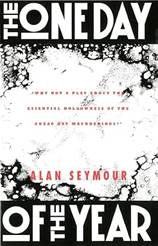
This Resource is for Year 12 students studying this new text ‘One Day of the Year’ a Play by Alan Seymour in the VCE Victorian English Curriculum for 2027.
If you want detailed tuition on this new text for VCE English in 2027 please contact me to set up classes.

Via email = margaretnmorris@gmail.com
Fees for one-on-one Lessons = $100 per 1 hour
Lessons online using Zoom include notes on the texts with essay scaffolding of prompts
Controversy Surrounding the Play
Alan Seymour wrote his play ‘One Day of the Year’ in 1958 only 13 years after the end of World War 2 in 1945 and 41 years after the end of World War 1. The controversy surrounding the play is that Seymour directly challenged the sacred Anzac Day myth and the heroic ‘digger’ archetype. Originally selected for the Adelaide Festival of Arts in 1960, the play was banned before rehearsals began, out of fear of offending the Returned Services League (RSL) and ex-servicemen. Seymour questioned the traditional, uncritical reverence of not only Anzac Day but also the Gallipoli campaign. He held a mirror up to the excessive drinking, brawling and hollowness that sometimes accompanied the commemorations in the late 1950’s and 1960’s. At the heart of the play Seymour poses the question: Is the Anzac legend still a viable national narrative?
Reading and Understanding the Play in Australian Society Today
However, the actual value of the play as an object of study and discussion for younger audiences today lies in its capacity to confront its audience with the startling message that our own current consensus around Anzac Day has not always been so firmly entrenched. Moreover, that there was a moment in the recent past when this ceremony and the values it was seen to enact were in fact open to dispute, even to outright rejection. In society today, Anzac Day’s significance to the younger generation is evolving and continues to resonate with all levels of contemporary society. Its meaning holds different levels of personal significance across generations and experiences.
The Play is Not a Rejection of Anzac Day
The final message of the play is not an unequivocal rejection of Anzac Day or the Anzac legend. Nevertheless, ‘The One Day of the Year’ affords its current audience the invaluable opportunity of re-examining the cultural function of such an event and to pose again across the distance of sixty years, the play’s central question: Is the Anzac legend a fitting and suitable narrative that describes the character of the nation or has it always been merely an annual display of a nation’s unexamined ‘nostalgia for violence’?
The Meaning of the Anzac Legend
At the centre of Seymour’s play is an emotionally charged examination of the symbolism, history, the deep personal investments and the ongoing legacy of the Anzac legend, particularly as this is commemorated each year on April 25.
Father / Son Conflict about Anzac Day
In the play Hughie Cook makes his own feelings clear when explaining to his university girlfriend Jan Castle why he is so opposed to the day “I can’t stand waste. Waste of lives, waste of men. That whole thing—Anzac—Gallipoli—was a waste” (p.20). The contrast comes in the form of Alf Cook, Hughie’s father, a veteran of the El Alamein campaign in the World War 2, and the son of a Gallipoli veteran. Alf is a man steeped in the values of the Anzac Legend, resulting in his intense personal investment in the significance of the day. Alf is proud and patriotic “Don’t shut me up, I’m not ashamed of it. I’m proud to be a bloody Australian. If it wasn’t for men like my old man this country’d never bin heard of. They put Australia on the map they did, the Anzacs did” (p. 55).
Wacka Dawson a Survivor of Gallipoli Strips Away the Bravado of Anzac Day
For Wacka Dawson, he represents the authentic, quiet remembrance of Anzac Day, having survived Gallipoli, he does not boast or gatekeep the day, instead he acts as the play’s moral compass. While the rest of the play highlights the loud, alcohol fuelled celebrations of Alf and the intellectual cynicism of Hughie, Wacka’s solitary moment strips away the politics and drunken bravado to show what Anzac Day truly means to those who fought. Rather than assert his superiority as an original ‘digger’, for Wacka, the symbol is not about nationalistic pride or a rowdy celebration, it is a deeply personal, quiet mourning for the young men who died and the grim reality of what they survived. At the dawn service, Wacka stands alone listening to “The Last Post”. This is the emotional heart of the play, revealing genuine, quiet trauma of a veteran who was at Gallipoli. Dot Cook remarks how Wacka keeps silent about his military service and everything he has been through “But—y’never say a word” (p. 73).